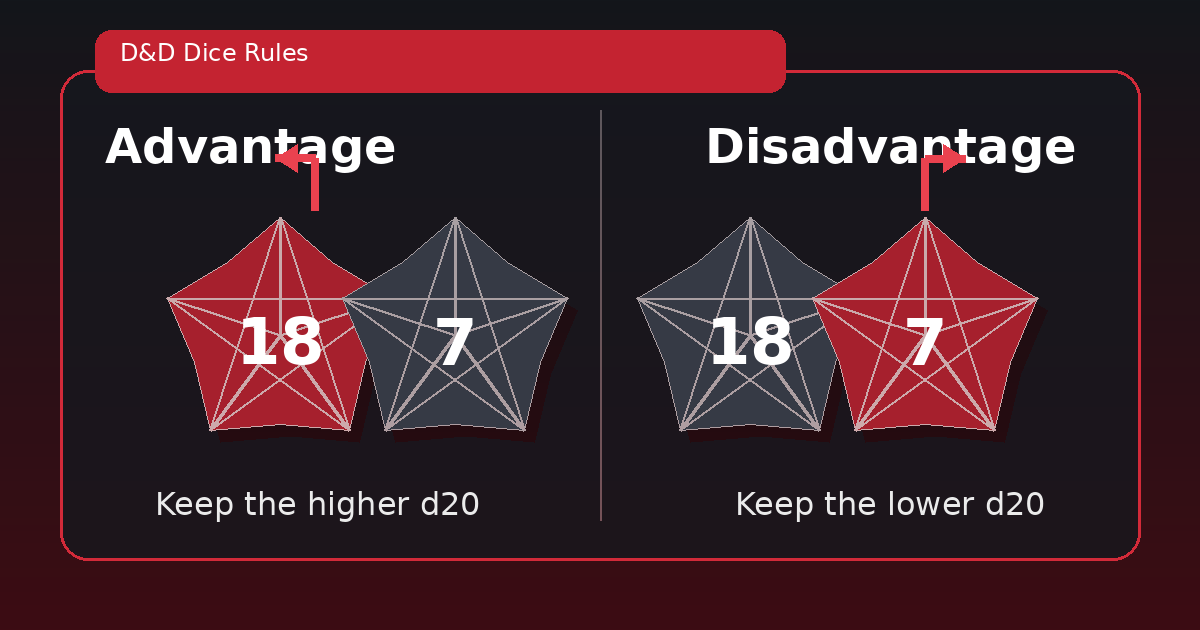
Advantage and disadvantage are two of the most important dice rules in modern Dungeons & Dragons. They are also two of the easiest to explain badly.
The rule, from the System Reference Document 5.2.1 (the free 2024 rules text, "Playing the Game", D20 Tests) [1]:
- Advantage: roll two d20s and use the higher.
- Disadvantage: roll two d20s and use the lower.
- Both at once: they cancel. Roll one d20.
- They don't stack. Three sources of advantage still means two d20s.
That is the short version. The useful version is what it does to your odds, when a DM should hand it out, and the mistakes that turn it into a bargaining chip.
What advantage means
The SRD says advantage "reflects the positive circumstances surrounding a d20 roll" [1]. The key word is circumstances. Your character is not permanently better. The moment is: the position, the preparation, the target, the timing.
You usually get it from special abilities and actions, and the DM can also decide the circumstances grant it [1]. Examples:
- Attacking a creature that can't see you [1].
- An ally's Help action on your next ability check [1].
- A spell such as Enhance Ability or Faerie Fire.
- A player's plan that genuinely changes the situation.
Advantage is not a prize for being vaguely clever. It is the DM saying, "yes, that specific thing makes this roll more favourable."
What disadvantage means
The opposite: something about the situation makes success harder than normal. Straight from the rules [1]:
- Attacking a target you can't see.
- A ranged attack against a target beyond normal range, or with an enemy within 5 feet of you who can see you.
- Being Poisoned (attack rolls and ability checks), Restrained or Blinded (your attack rolls).
- Wearing armour you lack training with (any D20 Test involving Strength or Dexterity, and no spellcasting).
Disadvantage should not punish every bad idea. Sometimes a bad idea just fails. Sometimes it needs a higher DC. Sometimes it causes a consequence with no roll at all. Disadvantage works best when the action is still possible but the conditions are clearly hostile.
Advantage is worth about +5, but only in the middle
Players often call advantage "+5". That is exactly right for one target number and wrong for most of the others.
Here is what it does to the chance of hitting a target number on the d20 alone. Computed exactly, assuming a fair d20 (advantage = 1 − (chance of failing)², disadvantage = (chance of success)²):
| You need | Normal d20 | Advantage | Disadvantage | Advantage is worth |
|---|---|---|---|---|
| 2+ | 95% | 99.75% | 90.25% | +1 |
| 5+ | 80% | 96% | 64% | +3.2 |
| 8+ | 65% | 87.75% | 42.25% | +4.55 |
| 11+ | 50% | 75% | 25% | +5 |
| 15+ | 30% | 51% | 9% | +4.2 |
| 18+ | 15% | 27.75% | 2.25% | +2.55 |
| Natural 20 | 5% | 9.75% | 0.25% | +1 |
"Worth" is the flat bonus that would give the same boost to your chance of success. Disadvantage is the mirror image: −5 at 11+, shrinking toward the edges.
Three things fall out of that table:
- Advantage matters most on coin-flip rolls. Needing an 11 goes from 50% to 75%. Needing a 2 barely moves.
- Disadvantage wrecks hard rolls. A 30% shot becomes 9%. Fire an arrow past normal range at a well-armoured target and you are praying, not aiming.
- Advantage nearly doubles your crit chance (5% to 9.75%), and disadvantage cuts it to one in four hundred.
Over the whole die, the average roll rises from 10.5 to 13.825 with advantage and falls to 7.175 with disadvantage.
Two d20s are better than one. Unless the DM said disadvantage.
A worked example. Your rogue has +5 Stealth and the guard's DC is 15, so you need a 10 on the die. Normal: 55%. Advantage: 79.75%. Disadvantage: 30.25%. The difference between sneaking with the fog and sneaking in armour you can't wear is the difference between "probably fine" and "probably arrested".
They cancel, and they don't stack
If a roll has both, it has neither, and you roll one d20. The SRD is blunt: this holds "even if multiple circumstances impose Disadvantage and only one grants Advantage or vice versa" [1].
So three reasons for advantage and one reason for disadvantage still gives a straight roll. Some players find this unfair. The dice do not hold a vote. It keeps the game fast. Nobody counts modifiers; you ask one question: favoured, hindered, both, or neither?
Stacking works the same way. Your rogue attacks from hiding while an ally distracts the target: two sources, still two d20s [1]. The second source isn't wasted, though. The DM can let it buy something else: better positioning, more information, a safer escape.
One more rule people miss. If you have advantage or disadvantage and something lets you reroll, such as Heroic Inspiration or the Halfling's Luck trait, you reroll one of the two dice, your choice, never both [1].
Advantage or a different DC?
Sometimes the DM has a choice: advantage, disadvantage, or move the DC?
- The character's situation changes: advantage or disadvantage.
- The task itself is easier or harder: change the DC.
Picking an ordinary lock with excellent tools: advantage. Picking an unusually complex lock: higher DC. A complex lock with excellent tools: high DC, with advantage.
The lock has its own difficulty. The character's situation changes how they roll against it. Keeping those apart keeps rulings consistent.
When DMs should give advantage
Rule of thumb: give advantage when the approach makes the roll meaningfully easier, but not automatic.
- A player braces a door before forcing it.
- A bard's argument uses information the NPC cares about.
- A ranger studies the tracks before following them.
- A fighter uses the terrain to pin an enemy into a bad position.
This rewards players for engaging with the fiction instead of treating every roll like a button press.
The danger is handing it out too often. If every colourful description earns advantage, it stops feeling special, and players learn to pad every action with a speech to fish for a second die. Give it when the description changes the situation, not when the description is longer.
When DMs should give disadvantage
When the obstacle is obvious and fair:
- Reading tiny text by candlelight.
- Firing through a storm at long range.
- Picking a lock while hanging from a rope.
- Recalling lore while panicked and bleeding.
Not when:
- The DM wants the player to fail.
- The player chose an option the DM did not expect.
- The scene needs drama but the penalty has no cause.
- The DM is annoyed and charges a mood tax.
Disadvantage comes from the world, not from the DM's frustration.
2014 or 2024? Two rules that changed
Most of this is the same in both editions. The SRD 5.1 text on stacking and cancelling says the same thing in older words [2]. Two common sources did change:
| SRD 5.1 (2014 rules) | SRD 5.2.1 (2024 rules) | |
|---|---|---|
| Exhaustion | Level 1 gives disadvantage on ability checks [2] | No disadvantage: every D20 Test drops by 2 per Exhaustion level [1] |
| Help, on an ability check | Characters who team up give the leader advantage; no proficiency needed [2] | You must have proficiency in the skill or tool you help with; the ally gets advantage on their next check with it [1] |
If your table plays the 2024 rules and someone says "I'm exhausted, so disadvantage", that is the old rule. It is now a flat −2 per level, which is gentler at first and much worse at level 4.
Player advice: earn it without asking for it
"Can I get advantage?" is a fair question. Asked every roll, it turns the game into a negotiation.
Describe what your character does and let the DM decide.
Instead of: "Can I get advantage on Persuasion?"
Try: "I mention the captain's missing scouts. We found their insignia earlier. I want him to know we are not random mercenaries."
Instead of: "Can I get advantage on Athletics?"
Try: "I wedge my shield under the slab first so I can lift from a better angle."
That gives the DM something concrete to reward.
DM advice: say yes, but not always
Advantage lets you reward good play without rewriting the encounter. Make it automatic, though, and the game loses texture. Other answers are often more interesting:
- "Yes, that gives you advantage."
- "No advantage, but I'll lower the DC."
- "No roll needed. That plan just works."
- "No advantage, but it changes what happens if you fail."
- "You can try, but conditions are awful. Still at disadvantage."
Rolling it on this site
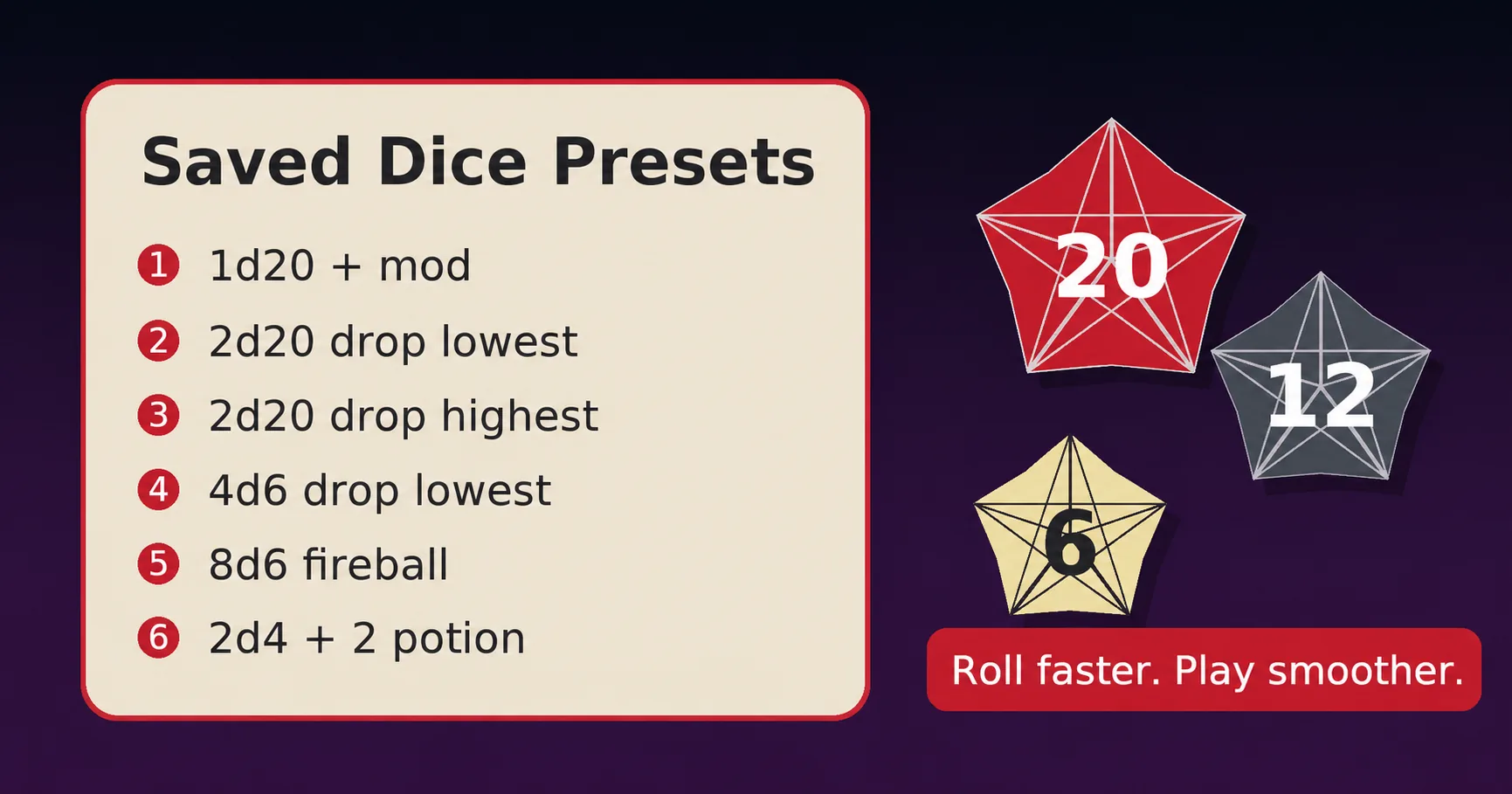
On the main roller, set a line to 2 × d20, tick the first option, and set it to Drop lowest 1 for advantage or Drop highest 1 for disadvantage. Put your modifier on "to total", and save the line so it waits for you next session.
On the 3D table, pick up two d20s and press DROP LOWEST for advantage or DROP HIGHEST for disadvantage.
| Roll | Dice | Setting |
|---|---|---|
| Normal | 1d20 + mod | None |
| Advantage | 2d20 + mod | Drop lowest 1 |
| Disadvantage | 2d20 + mod | Drop highest 1 |
The short of it
Two d20s are fast, visible and dramatic. Everyone at the table knows what they mean: a little burst of hope, or a little dread, before the dice even land.
Used well, the rule rewards smart play and keeps the game moving. Used carelessly, it becomes a bargaining chip or a blunt punishment. Let the situation matter, keep rulings clear, and remember advantage feels best when it is earned.
Table Talk
Tia: Why do players ask for advantage on every single roll?
Rohan: Because they think it's plus five. It's plus five at an 11. At a 2 it's plus one.
Tia: They're not doing maths, Rohan. A second die feels like the world is on your side. People chase that.
Rohan: Then they're chasing it on the wrong rolls. Save the fishing for coin flips.
Tia: Or stop fishing. Say what your character does. The mentioned insignia, the shield under the slab. Give the DM a reason.
Rohan: Long speech, same situation, no advantage. Length isn't a plan.
Tia: Agreed. And the flip side: if a DM hands out disadvantage because they're annoyed, the table notices.
Rohan: Mood tax. Disadvantage comes from the world. Firing past normal range at a well-armoured target, that's the world.
Tia: At 30% you drop to 9%. That's not aiming.
Rohan: That's praying.
References
- Wizards of the Coast. System Reference Document 5.2.1. 2025. CC-BY-4.0. Sections: "Playing the Game" (D20 Tests, Advantage/Disadvantage; Combat, Ranged Attacks, Unseen Attackers and Targets) and "Rules Glossary" (Advantage, Disadvantage, Armor Training, Blinded, Exhaustion, Help, Heroic Inspiration, Poisoned, Restrained). https://media.dndbeyond.com/compendium-images/srd/5.2/SRD_CC_v5.2.1.pdf
- Wizards of the Coast. System Reference Document 5.1. 2016, released under CC-BY-4.0 in 2023. Sections: "Using Ability Scores" (Advantage and Disadvantage, Working Together) and "Appendix PH-A: Conditions" (Exhaustion). https://www.dndbeyond.com/srd