Six numbers decide whether your wizard can hit a door with a fireball and whether your barbarian can spell "door". The method your table uses to make them sets the campaign's power level and fairness before anyone says a word in character.
Some methods make lopsided, memorable heroes. Some keep the party level. Some reward nerve. This guide shows the actual odds for each, so you pick on purpose instead of by habit.
The Short Answer
- Most 5E tables: 4d6 drop the lowest. Rolling is fun, and the average result matches the standard array.
- Fairness first: point buy, or the standard array, which is a point-buy build.
- Old-school danger: 3d6 in order. Your character is whatever the dice say.
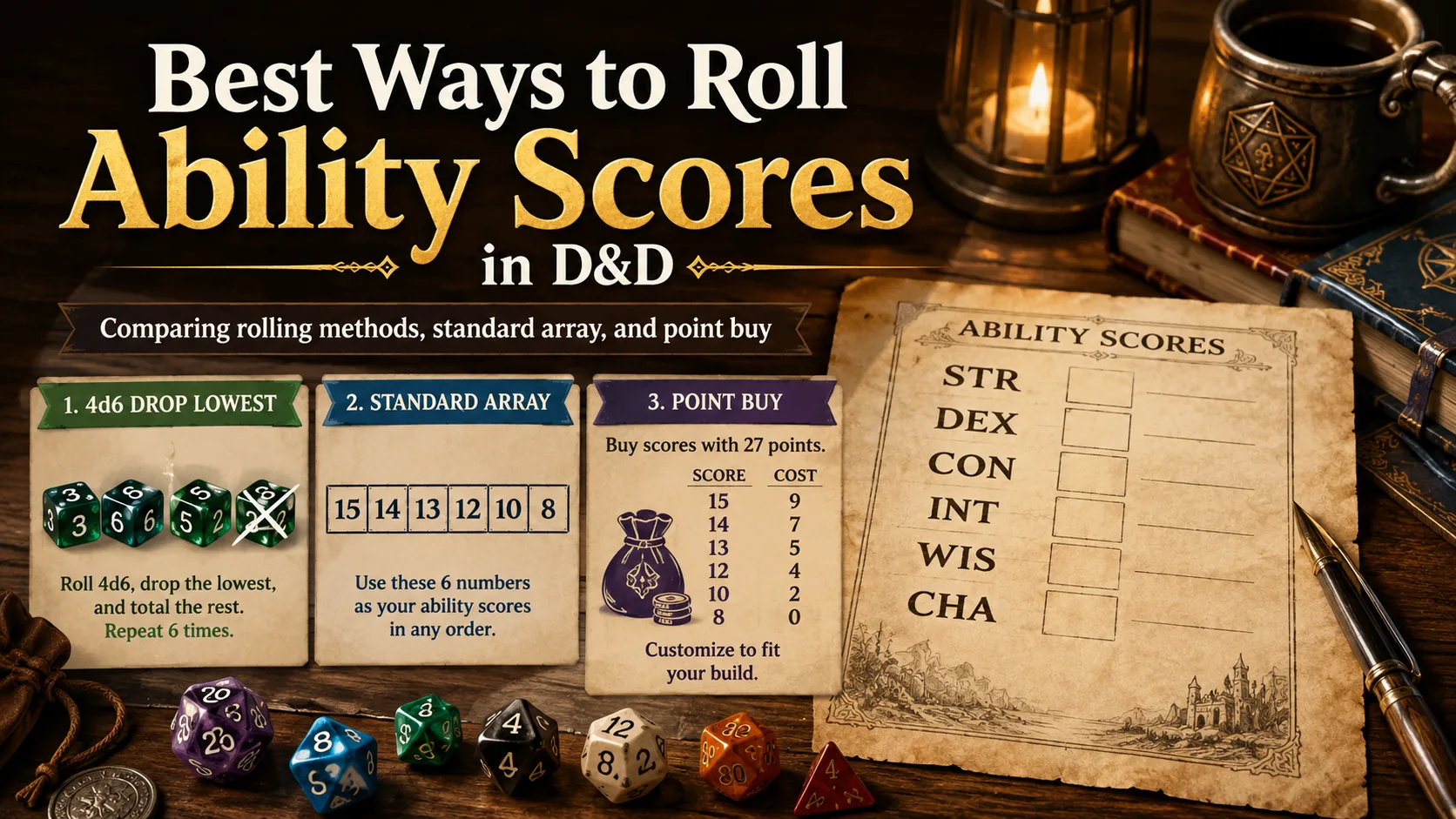
The 2024 rules (SRD 5.2.1, "Character Creation", Step 3) offer three methods: standard array, random generation (4d6 drop the lowest, six times) and point cost [1]. Everything else here is a variant or a throwback.
The Odds, Worked
Every number below comes from a script: exact counts over all 216 (3d6) or 1,296 (4d6) outcomes for single scores, and 400,000 simulated six-score sets for whole characters [2]. "Modifier total" adds the six ability modifiers from the SRD's table (10–11 is +0, 14–15 is +2, and so on) [1].
One score
| 3d6 | 4d6 drop lowest | |
|---|---|---|
| Average score | 10.5 | 12.24 |
| Chance of 16 or more | 4.6% | 13.0% |
| Chance of exactly 18 | 0.46% (1 in 216) | 1.62% (7 in 432) |
| Chance of 13 or more | 25.9% | 48.8% |
| Chance of 8 or less | 25.9% | 10.5% |
A whole character (six scores, sorted high to low)
| Best | 2nd | 3rd | 4th | 5th | Worst | Modifier total | |
|---|---|---|---|---|---|---|---|
| Standard array | 15 | 14 | 13 | 12 | 10 | 8 | +5 |
| 3d6 (average set) | 14.2 | 12.5 | 11.1 | 9.9 | 8.5 | 6.8 | +0 |
| 4d6 drop lowest (average set) | 15.7 | 14.2 | 13.0 | 11.8 | 10.4 | 8.5 | +5.2 |
| 4d6, best of three sets | 16.3 | 15.0 | 13.9 | 12.8 | 11.5 | 9.6 | +8.2 |
Three things jump out:
- The standard array is the average 4d6 character. Its modifier total (+5) sits right on 4d6's mean (+5.2).
- 4d6 is a coin flip against the array. A 4d6 set beats the array's +5 total 47.8% of the time, ties 11.1%, and falls short 41.1%. The middle 80% of sets land between +1 and +10. That spread is the real gap between players at the table.
- Best of three sets is a power bump, not a safety net. It beats the array 85.8% of the time. Fine for a heroic campaign; know what you are buying.
At least one 18 in a set of six: 9.3% on 4d6 drop lowest, 2.7% on 3d6.
Method 1: 4d6 Drop the Lowest
The rolled method in the current rules [1].
How it works: roll four d6, drop the lowest die, add the other three. Do it six times, then assign the six totals to your abilities.
Example: you roll 6, 5, 3, 1. Drop the 1. Your score is 14. The 1 goes back in the bag to think about what it did.
Strengths
- The fun of rolling, with a floor: a 3 needs all four dice on 1 (1 in 1,296).
- Characters come out distinct. Nobody else has your 17 and your 7.
- Everyone knows it. No explaining.
Weaknesses
- Luck gaps are real. One player at +10 and another at +1 is a normal night.
- Hot streaks make characters with no weak spot, which is less fun to play than it sounds.
Best for: typical 5E campaigns; groups who want to roll and still end up competent.
Method 2: Point Buy
Not a roll, but it belongs here: it is the fairest option in the book.
How it works (SRD 5.2.1): you have 27 points to spend. Scores run from 8 to 15 before background bonuses [1].
| Score | 8 | 9 | 10 | 11 | 12 | 13 | 14 | 15 |
|---|---|---|---|---|---|---|---|---|
| Cost | 0 | 1 | 2 | 3 | 4 | 5 | 7 | 9 |
Note the jump: 13 → 14 costs 2 points, and 14 → 15 costs 2 more. High scores are deliberately expensive.
Some legal 27-point builds:
- 15, 15, 15, 8, 8, 8: three strengths, three dump stats. The glass cannon.
- 15, 14, 13, 12, 10, 8: the standard array. It costs exactly 27.
- 13, 13, 13, 12, 12, 12: no weakness, no highlight. The accountant.
Strengths: perfectly fair, great for planning a build from level 1, a predictable baseline for the DM.
Weaknesses: no surprises, and optimisers find the same three builds every time.
Best for: balanced, party-focused campaigns, organised play, groups who hate swingy starts.
Method 3: Standard Array
The quickest start in D&D.
How it works: assign 15, 14, 13, 12, 10, 8 to your six abilities [1]. The SRD's "Standard Array by Class" table suggests where each number goes if you want it done for you.
Strengths: thirty seconds, perfectly fair, ideal for new players and one-shots.
Weaknesses: every character's numbers look the same. No happy accidents.
Best for: beginners, one-shots, convention games, teaching.
The array is no penalty for not rolling. It is the average roll, handed to you.
Method 4: 3d6 in Order
The original. In the 1974 rules you rolled three dice for each ability, in order, and played what you got.
How it works: 3d6 for Strength, then Dexterity, Constitution, Intelligence, Wisdom, Charisma. No swapping.
Strengths
- The character finds you. A fighter with 7 Strength and 16 Charisma becomes a captain who leads from the back.
- Fast.
- Memorable, the way car crashes are memorable.
Weaknesses
- The average set totals +0 in modifiers, five below the array.
- A third of sets (34.6%) have no score above 13.
- In 5E, a class whose main ability rolls a 7 is a long campaign of misses.
Best for: OSR games, funnel adventures, lethal one-shots, tables who treat bad rolls as story.
3d6 in order: because nothing builds character like a Strength of 5.
Method 5: 3d6, Arrange to Taste
The softer throwback: roll 3d6 six times, then assign.
How it works: Method 4's dice, but you choose where each total goes. At least the 14 lands where it counts.
Strengths: the old-school feel without dooming your chosen class. Characters are grounded, not superhuman.
Weaknesses: the numbers stay low for 5E. Expect roughly a 14, a 12, an 11 and three scores you'd rather not discuss.
Best for: gritty or low-magic campaigns where ordinary people are the point.
Method 6: Roll Several Sets, Pick One
The comfort blanket: roll three full sets of 4d6 drop lowest and keep the one you like.
Strengths: you still roll, and a disastrous set no longer ruins your week.
Weaknesses: a hidden power boost. The chosen set averages +8.2 in modifiers against the array's +5. It takes longer, too.
Best for: heroic campaigns, and tables where someone always rolls a 5 and sulks.
So What Is Actually the Best?
| If your table wants... | Use |
|---|---|
| Rolling, with competent heroes | 4d6 drop the lowest |
| Nobody ahead of anybody | Point buy |
| To start in five minutes | Standard array |
| Danger and odd characters | 3d6 in order |
| Old-school, but you pick your class | 3d6, arrange |
| Big heroes and no sulking | Best of three 4d6 sets |
My pick for a typical 5E group is still 4d6 drop the lowest: the best mix of excitement, surprise and decent power, and everyone already knows it.
It is not objectively superior. Plenty of tables use it from habit, not choice. For some groups point buy makes the better campaign; for others, 3d6 in order makes the characters they still talk about ten years later. The method serves the campaign, not the other way round.
How to Set It Up in DnD Dice Roller
On the main roller:
4d6 drop the lowest
- Dice count 4, dice type d6.
- Tick the first advanced option, choose Drop and lowest, and set the count to 1.
3d6 (in order or arranged)
- Dice count 3, dice type d6. No advanced options.
- Roll six times. In order: write them down Strength first. Arranged: assign as you like.
A whole character in one click
- Add lines with + until you have six, and label them Strength, Dexterity, Constitution, Intelligence, Wisdom, Charisma.
- Set each to 4d6 drop the lowest 1.
- Press ALL. Every score rolls at once and the log keeps the set.
Want to watch the dice tumble? The 3D roller rolls on a table your friends can join. For a printable guide, see the free booklets.
Final Thoughts
Ability scores feel like paperwork before the real game. They aren't. They set the power level, fairness and tone of the campaign before the first scene.
Want heroes? Use a generous method. Want fairness? Use a fixed one. Want danger and weird characters? Use a harsh one. Not sure? Roll 4d6, drop the lowest, and meet whoever turns up.
Table Talk
Rohan: Point buy. Everyone starts level. Nobody sulks.
James: Where's the fun? I want the 7 in Strength and the story that comes with it.
Rohan: 4d6 against the array is a coin flip. Ahead 47.8% of the time, behind 41.1%.
James: So nearly half the time I beat the array, and the rest of the time I get a story. I win either way.
Rohan: The story is a fighter who can't hit anything.
James: A captain who leads from the back. It says so right up there.
Rohan: Tip, then. Whatever method you pick, roll at session zero, in the open, where the table can see.
James: Deal. And if someone rolls a 5, best of three sets.
Rohan: That's +8.2 against the array's +5. A hidden power bump. Know what you're buying.
James: I'm buying no sulking. Worth every point.
References
- Wizards of the Coast. System Reference Document 5.2.1, "Character Creation", Step 3: Determine Ability Scores (Standard Array, Random Generation, Point Cost, Ability Scores and Modifiers table). 2025. CC-BY-4.0. https://www.dndbeyond.com/srd
- DnD Dice Roller. Odds computed for this article in Python: exact enumeration of all 3d6 and 4d6 outcomes; 400,000 simulated six-score sets (200,000 for best of three). 2026.