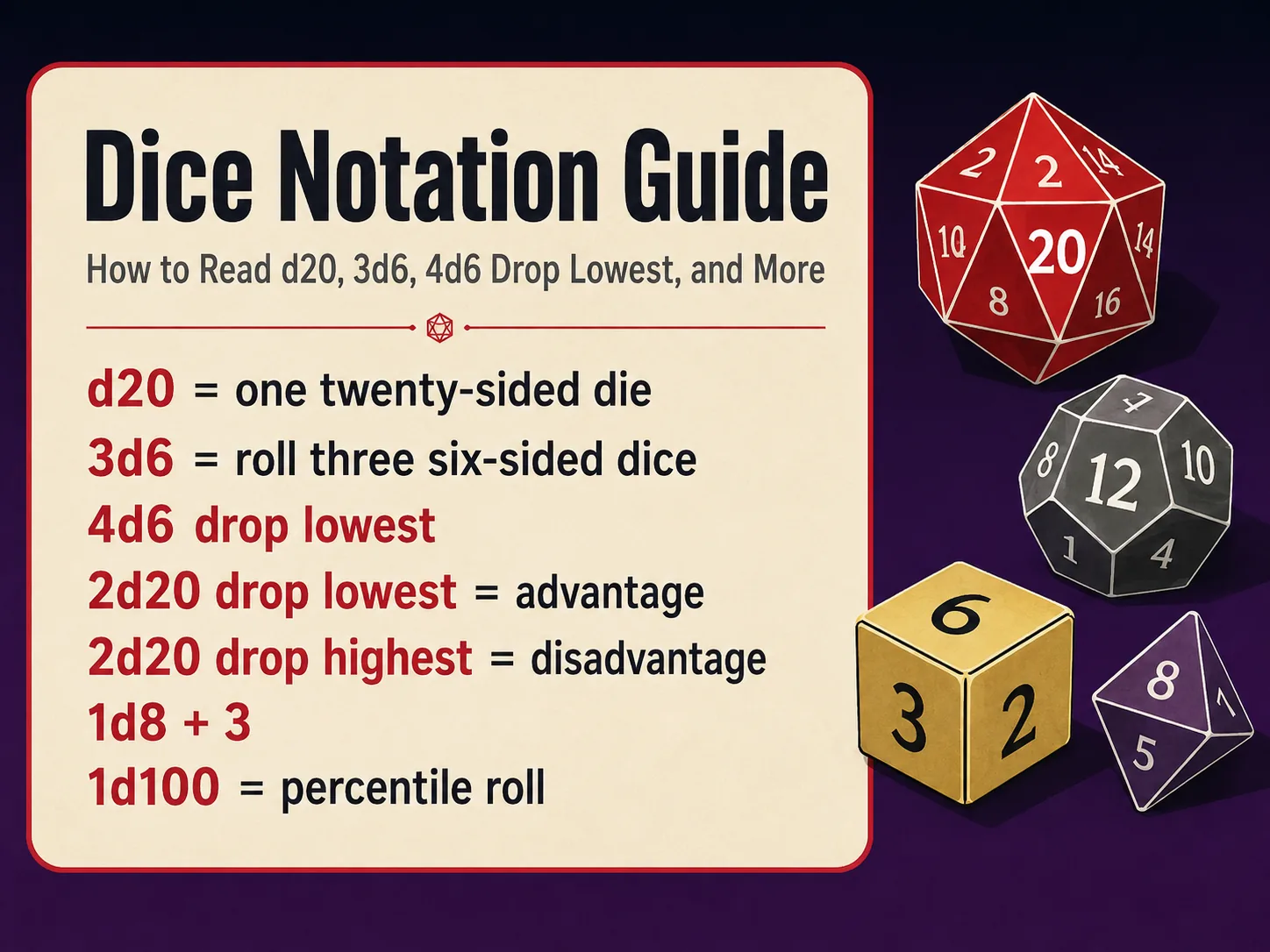
1d20 + 5. 2d6. 4d6 drop the lowest. If a character sheet, spell or stat block has ever shouted this at you, you were reading dice notation: a shorthand for how many dice to roll, which kind, and what to do with the result.
It looks like algebra for about five minutes. This guide gets you through those five minutes, then into drop, reroll and per-die limits, with the odds worked out so you know what each rule actually does.
The Core Formula: XdY
X= how many diced= "die"Y= how many sides each die has
So 1d6 is one six-sided die, 2d8 is two eight-sided dice added together, 3d4 is three four-siders (mind your feet). No number before the d means one: d20 and 1d20 are the same roll.
The Standard Set
| Die | Typical jobs in 5E |
|---|---|
| d4 | Daggers, Magic Missile darts |
| d6 | Shortswords, Sneak Attack, Fireball |
| d8 | Longswords, Cure Wounds |
| d10 | Heavy crossbows, Fire Bolt |
| d12 | Greataxes |
| d20 | Every D20 Test: attack rolls, ability checks, saving throws |
| d100 | Percentile tables: trinkets, magic item effects |
The 2024 rules call attack rolls, ability checks and saving throws "D20 Tests" [1]. Damage uses the smaller dice.
Adding Modifiers
1d20 + 5, 2d6 + 3, 1d8 − 1: roll, total the dice, then add or subtract.
| Notation | Dice show | Result |
|---|---|---|
1d20 + 5 |
14 | 19 |
2d6 + 3 |
4, 2 | 9 |
1d8 − 1 |
6 | 5 |
Modifier to the total vs to each die
DnD Dice Roller lets you apply a modifier to total or to each die. Same dice, very different answer:
| Dice show 4, 2 | Range | Average | |
|---|---|---|---|
2d6 + 3 to total |
4 + 2 + 3 = 9 | 5–15 | 10 |
2d6 + 3 to each |
(4+3) + (2+3) = 12 | 8–18 | 13 |
D&D almost always means to total. Per-die modifiers are for homebrew, other systems, and testing odd ideas.
Percentile Rolls: d100
A d100 gives 1 to 100. Most tables roll two d10s: one for tens (often marked 00, 10, 20…), one for ones.
| Tens die | Ones die | Result |
|---|---|---|
| 40 | 3 | 43 |
| 00 | 7 | 7 |
| 90 | 0 | 90 |
| 00 | 0 | 100 |
The SRD uses 1d100 for its Trinkets table and for dozens of magic item effects [1]. The site's d100 rolls 1–100 directly, no conversion needed. (A real hundred-sided die exists. It looks like a golf ball and takes roughly forever to stop rolling.)
Why Dice Count Changes the Shape
More dice, more middle. 1d12 and 2d6 both top out at 12, but they behave nothing alike:
| Total | 1 | 2 | 3 | 4 | 5 | 6 | 7 | 8 | 9 | 10 | 11 | 12 |
|---|---|---|---|---|---|---|---|---|---|---|---|---|
| 1d12 | 8.3% | 8.3% | 8.3% | 8.3% | 8.3% | 8.3% | 8.3% | 8.3% | 8.3% | 8.3% | 8.3% | 8.3% |
| 2d6 | 0% | 2.8% | 5.6% | 8.3% | 11.1% | 13.9% | 16.7% | 13.9% | 11.1% | 8.3% | 5.6% | 2.8% |
A 7 is twice as likely on 2d6 as on 1d12. A 12 is three times less likely. That is why a greatsword (2d6) feels steady and a greataxe (1d12) feels moody, even though their averages are 7 and 6.5.
Stack enough dice and the middle takes over. Fireball is 8d6: average 28, and 64% of casts land between 24 and 32. Only 6% come in at 20 or under.
Drop Lowest and Drop Highest
Roll extra dice, then ignore some.
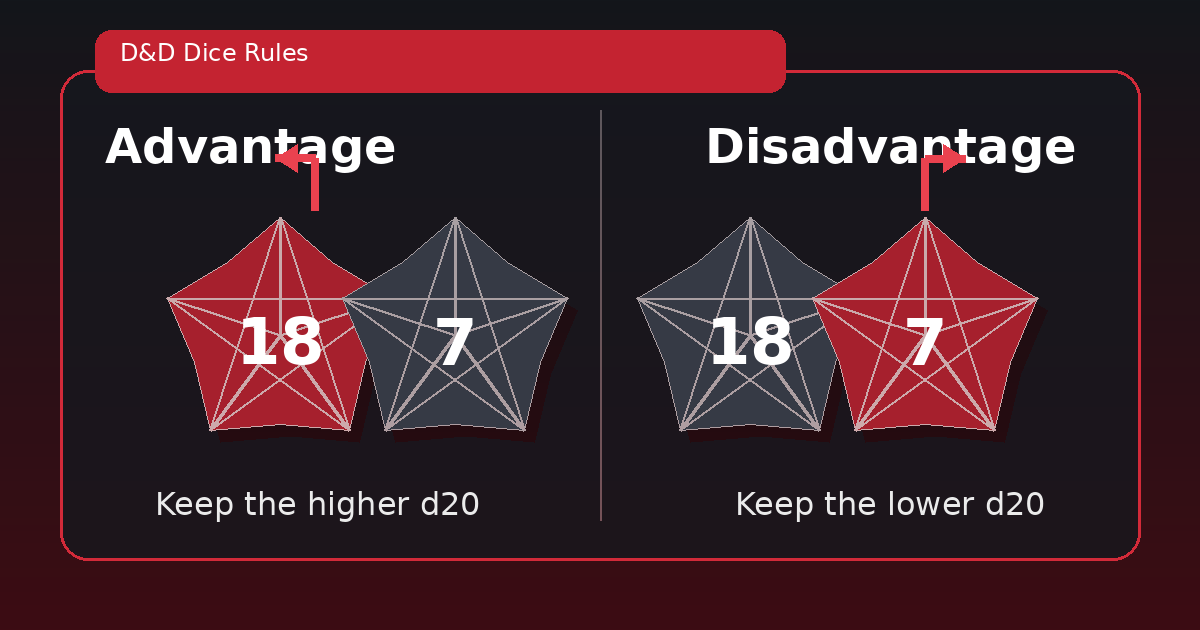
4d6 drop the lowest: roll four, ignore the lowest, add three. The rolled method for ability scores in the current rules [1]. Roll 6, 5, 3, 1 → drop the 1 → 14. Average 12.24, against 10.5 for plain 3d6.2d20 drop the lowestis Advantage: roll two d20s and use the higher [1].2d20 drop the highestis Disadvantage: use the lower [1].
What Advantage and Disadvantage do to your chance of success:
| Need to roll... | Flat d20 | Advantage | Disadvantage |
|---|---|---|---|
| 5 or more | 80% | 96% | 64% |
| 10 or more | 55% | 79.8% | 30.2% |
| 11 or more | 50% | 75% | 25% |
| 15 or more | 30% | 51% | 9% |
| 20 | 5% | 9.8% | 0.25% |
Average d20 with Advantage: 13.8. With Disadvantage: 7.2. Rolling a natural 20 with Disadvantage is a 1-in-400 event; frame it.
Keep vs drop, in other tools
Virtual tabletops often write the same thing as "keep". Foundry VTT uses 4d6kh3 (keep highest three) or 4d6dl (drop lowest), and 2d20kh for Advantage. See the Foundry dice modifier reference for the full list [2]. kh3 and dl1 on 4d6 are the same roll, written from opposite ends.
Reroll Lowest and Reroll Highest
Drop and reroll sound alike. They are not.
- Drop: the die is thrown away and doesn't count.
- Reroll: the die is rolled again, and the new result replaces the old, even if it's worse.
Drop is a clean break-up. Reroll is getting back together and hoping it goes better this time.
Example: roll 4d6, get 6, 4, 2, 1. Reroll the lowest: the 1 comes up 5. You keep all four: 6, 4, 2, 5 = 17. Dropping would have given 12.
The rules use rerolls constantly. Heroic Inspiration lets you reroll any die immediately after rolling it, and you must use the new roll. A halfling's Luck rerolls a 1 on a D20 Test [1].
Minimum and Maximum Per Die
A minimum per die raises low faces: 1d10, minimum 2, turns a 1 into a 2. A maximum per die caps high ones: 1d8, maximum 6, turns a 7 or 8 into a 6.
The best real example is the Great Weapon Fighting style, which changed from a reroll to a minimum between editions:
| SRD 5.1 (2014) | SRD 5.2.1 (2024) | |
|---|---|---|
| Rule | Roll a 1 or 2 on a damage die: reroll it, keep the new roll [3] | Treat any 1 or 2 on a damage die as a 3 [1] |
| Notation | reroll 1s and 2s, once | minimum 3 per die |
Greatsword 2d6 average |
8.33 | 8.00 |
| Chance of 5 or less | 8.6% | 0% |
The old version averages slightly more; the new one can never whiff. Plain 2d6 averages 7 and rolls 5 or less 27.8% of the time, so both styles are a big upgrade.
To try the 2024 version on the site: 2d6, tick the second advanced option, Minimum, 3 per die. (The site's reroll option rerolls the lowest N dice, not every die showing 1 or 2, so the 2014 rule is only approximate.)
Common D&D Rolls
All from SRD 5.2.1 [1].
| Roll | Notation | Average |
|---|---|---|
| Attack roll, +7 to hit | 1d20 + 7 |
17.5 |
| Longsword, +4 Strength | 1d8 + 4 |
8.5 |
| Greatsword, +4 Strength | 2d6 + 4 |
11 |
| Fireball | 8d6 |
28 |
| Potion of Healing | 2d4 + 2 |
7 |
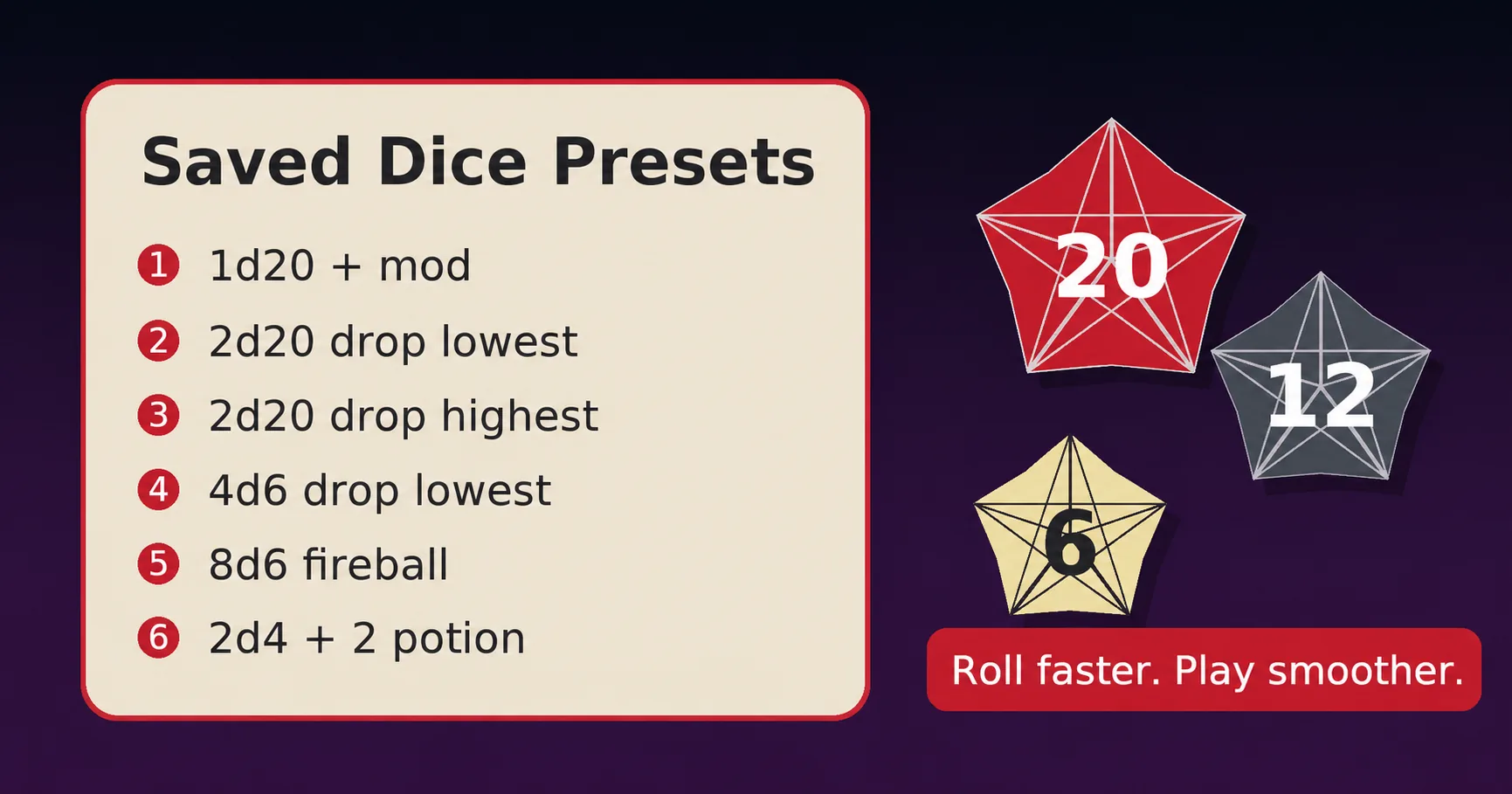
| Ability score | 4d6 drop lowest 1 |
12.24 |
| Advantage | 2d20 drop lowest 1 |
13.8 |
| Disadvantage | 2d20 drop highest 1 |
7.2 |
Every spell and monster page on this site shows its damage dice with the full odds. Try Cure Wounds or browse the monsters.
How to Read Any Formula
Five questions, in order:
- How many dice?
- What kind?
- Is there a modifier?
- Does it apply to the total or to each die?
- Any extra rules: drop, reroll, minimum, maximum?
1d10 + 5, minimum 2 per die → one d10; add 5 to the total; the die itself can't count below 2. Range 7–15, average 10.6.
Common Beginner Mistakes
- Treating
2d6like1d12. Same top number, different shape. See the table above. - Losing track of total vs each.
2d6 + 3to each adds 6, not 3. - Mixing up drop and reroll. Drop removes a die. Reroll gives it another go and you're stuck with the result.
- Assuming every tool writes it the same way. "Drop lowest" in one app is "keep highest" in another. Check the settings when something looks off.
Doing It in DnD Dice Roller
The main roller handles everything in this guide:
- plain rolls like
d20,2d6,1d8 + 3 - multiple labelled lines, all rolled at once with ALL
- modifiers to total or to each die
- drop or reroll, lowest or highest, up to five dice
- minimum or maximum per die
For dice you can watch land, use the 3D roller. For a printable cheat sheet, grab the dice notation booklet from Books.
Final Thoughts
Start with four: d20, 2d6, 1d8 + 3, 4d6 drop the lowest. Once those read at a glance, the rest is just more adjectives on the same sentence.
Table Talk
Arthur: The mistake that costs people is drop versus reroll. Drop throws the die away. Reroll means you live with the new one.
James: So if I reroll my 1 and get another 1...
Arthur: You keep the 1. The rule says you must use the new roll.
James: Beautiful. Two chances to fail.
Arthur: Greatsword or greataxe, then. Same top number.
James: Greataxe. 1d12 is moody, and so am I.
Arthur: 2d6 rolls a 7 twice as often and averages half a point more. The book is on my side.
James: Averages don't make stories. A natural 20 with Disadvantage does. One in 400. I'm framing it.
Arthur: Practical tip: if an app gives a strange result, check whether it says drop lowest or keep highest. On 4d6, kh3 and dl1 are the same roll.
James: And if it still looks wrong, blame the dice. It's tradition.
References
- Wizards of the Coast. System Reference Document 5.2.1: "Playing the Game" (D20 Tests; Advantage/Disadvantage; Heroic Inspiration; Critical Hits), "Character Creation" (Generate Your Scores), "Character Origins" (Halfling: Luck), "Feats" (Great Weapon Fighting), "Equipment" (Weapons; Potion of Healing), "Spells" (Fireball). 2025. CC-BY-4.0. https://www.dndbeyond.com/srd
- Foundry Gaming LLC. "Dice Modifiers." Foundry Virtual Tabletop Knowledge Base. https://foundryvtt.com/article/dice-modifiers/
- Wizards of the Coast. System Reference Document 5.1, "Classes: Fighter", Fighting Style: Great Weapon Fighting. 2016, CC-BY-4.0 release 2023. https://media.wizards.com/2023/downloads/dnd/SRD_CC_v5.1.pdf
- DnD Dice Roller. Odds in this article computed in Python by exact enumeration of every outcome. 2026.