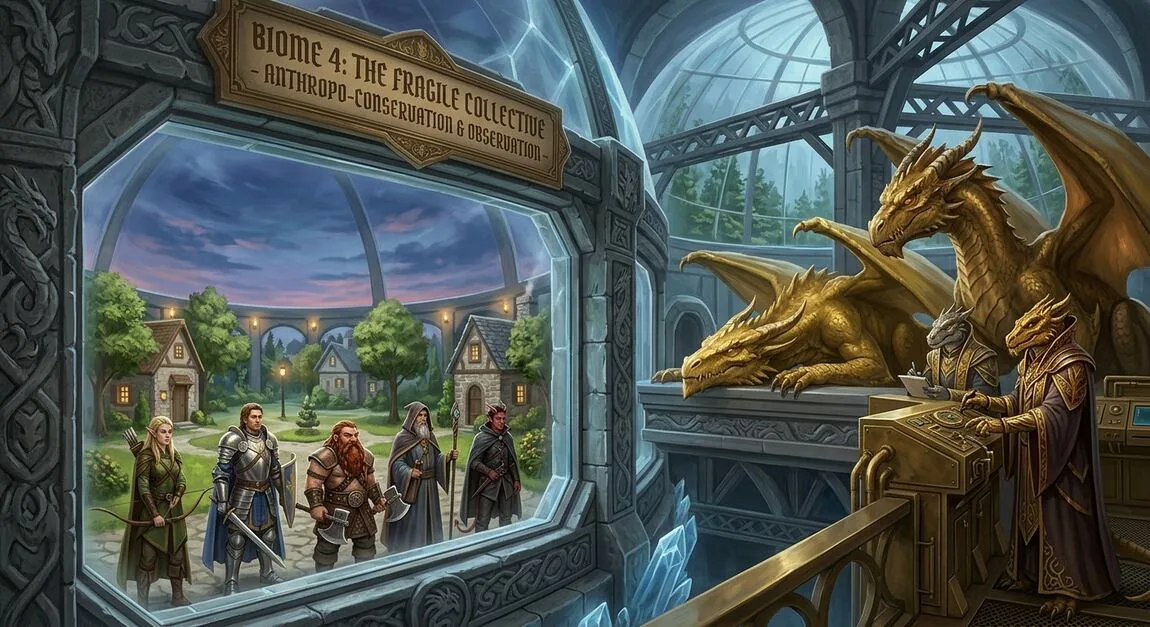
The 2014 rules called them races. The 2024 rules call them species, and the change is more than the name. A 2014 dwarf got +2 Constitution and walked at 25 feet. A 2024 dwarf gets no ability score increase at all, walks at 30 feet, and sees twice as far in the dark.
The free System Reference Document 5.2.1 [1] has nine species: Dragonborn, Dwarf, Elf, Gnome, Goliath, Halfling, Human, Orc and Tiefling. Rohan wants the numbers on every one. Tia wants to know why the height of your character might change how you play. This post gives both: what a species is now, what changed from 2014, each species with its best trait worked out, and the research on the body you choose.
What a species gives you in 2024
From SRD 5.2.1, "Character Origins", Parts of a Species [1]:
- Creature Type. "Every species in 'Character Origins' is Humanoid."
- Size. Small or Medium. Humans and Tieflings choose.
- Speed. 30 feet, or 35 for Elves (Wood Elf lineage) and Goliaths.
- Special Traits. Everything else.
What's missing is the point. A species no longer touches your ability scores. Those come from your background now, which we covered in D&D 2024 backgrounds and origin feats. The SRD also says members of most species "live for about 80 years" and all "reach physical maturity at about the same age" [1].
What changed from 2014
From SRD 5.1, "Races" [2], set against SRD 5.2.1 [1]:
| 2014 (SRD 5.1) | 2024 (SRD 5.2.1) | |
|---|---|---|
| Name | Race | Species |
| Ability scores | Every race raised some: Dwarf +2 Con, Tiefling +2 Cha and +1 Int | None. Your background does it |
| The list | Dwarf, Elf, Halfling, Human, Dragonborn, Gnome, Half-Elf, Half-Orc, Tiefling | Half-Elf and Half-Orc gone; Goliath and Orc in |
| Subraces | Hill Dwarf, High Elf, Lightfoot Halfling, Rock Gnome | Lineages and legacies for Elves, Gnomes and Tieflings; Giant Ancestry for Goliaths |
| Dwarf, Gnome, Halfling Speed | 25 feet | 30 feet |
| Dwarf Darkvision | 60 feet | 120 feet |
| Alignment, languages | Listed per race | Not part of the species |
Three changes worth knowing by name:
- Dwarven Toughness was only for Hill Dwarves in 2014 [2]. Every Dwarf has it now [1].
- Tieflings had fire resistance and one spell list in 2014 [2]. In 2024 you pick a Fiendish Legacy: Abyssal (poison), Chthonic (necrotic) or Infernal (fire), each with its own cantrip and spells [1].
- Halfling Luck covers the same three rolls as before: attack rolls, ability checks and saving throws, which 2024 groups as "D20 Tests" [1][2].
The Dragonborn breath weapon, then and now
The biggest rewrite in the chapter. In 2014 the breath took your whole action, dealt 2d6, and came back after a short rest [2]. In 2024 it replaces one attack in the Attack action, deals 1d10, and you get uses equal to your Proficiency Bonus per Long Rest [1]. You choose a 15-foot Cone or a 30-foot Line each time, and at level 5 you grow spectral wings and fly for 10 minutes once per Long Rest [1].
Expected damage to one Goblin Warrior (Dexterity save +2), for a Dragonborn with Constitution +2, save for half [3]. For 2014 we assume two short rests a day, so three breaths:
| Level | Save DC | 2014: per breath | 2014: per day | 2024: per breath | 2024: per day |
|---|---|---|---|---|---|
| 1 | 12 | 4.9 | 14.8 | 3.9 | 7.7 (2 uses) |
| 5 | 13 | 5.1 | 15.4 | 8.1 | 24.4 (3 uses) |
| 11 | 14 | 10.7 | 32.2 | 12.7 | 50.7 (4 uses) |
The 2014 breath wins at level 1. From level 5 the 2024 breath wins, and it wins on action economy too. A level 5 Fighter with Extra Attack can breathe and still swing a sword in the same turn. In 2014 the breath was the whole turn.
All nine species, with the trait that matters most
Every rule below is SRD 5.2.1, "Character Origins", Species Descriptions [1]. Every number is an exact count over the faces [3].
| Species | Size, Speed | Best trait | What it's worth |
|---|---|---|---|
| Dragonborn | Medium, 30 | Breath Weapon, resistance to your dragon's damage type | See table above |
| Dwarf | Medium, 30 | Dwarven Toughness: +1 HP per level | Wizard with Con +2: 32 HP → 37 at level 5, +16% |
| Elf | Medium, 30 (Wood Elf 35) | Lineage spells; Trance: a Long Rest in 4 hours | High Elf gets Misty Step free once per Long Rest at level 5 |
| Gnome | Small, 30 | Gnomish Cunning: Advantage on Int, Wis and Cha saves | Save +0 vs DC 13: 40% → 64% |
| Goliath | Medium, 35 | Giant Ancestry boon, PB uses per Long Rest; Large Form at level 5 | Stone's Endurance: 8.5 damage blocked a use, 17 a day at level 1 |
| Halfling | Small, 30 | Luck: reroll a natural 1 on any D20 Test | Natural 1 sticks 0.25% of the time, not 5% |
| Human | Small or Medium, 30 | Resourceful: Heroic Inspiration every Long Rest; Versatile: an Origin feat | One failed 50% roll becomes a 75% roll, every day |
| Orc | Medium, 30 | Relentless Endurance: drop to 1 HP instead of 0, once per Long Rest; Adrenaline Rush | Rush: 4 Temporary HP per Short Rest at level 1, 9 at level 5 |
| Tiefling | Small or Medium, 30 | Fiendish Legacy: resistance, a cantrip, spells at 3 and 5 | Infernal: Fire Bolt, Hellish Rebuke, Darkness |
A few notes the table can't hold:
The Halfling's Luck is small and constant. On an attack that needs 11, it lifts your hit chance from 50% to 52.5%. The real gift is the fumble. Tables that play a natural 1 as a disaster see one every 20 rolls; a Halfling sees one every 400 [3].
Halfling Luck: a natural 1 is only a first draft.
The Human is the quiet best pick. Heroic Inspiration lets you "reroll any die immediately after rolling it" [1]. A Human wakes up with it every day, plus an extra Origin feat and a skill. That's two Origin feats at level 1 when everyone else has one.
The Goliath hits hardest early. Pick Fire Giant and each hit can add 1d10 Fire damage, two times a day at level 1, three at level 5: 11 and 16 extra damage a day [3]. Or pick Stone Giant and shrug off 17 damage a day. At level 5 Large Form gives Advantage on Strength checks and +10 feet of Speed for 10 minutes.
The Orc keeps the old trick and loses the other. Relentless Endurance is the 2014 Half-Orc trait, same rule [1][2]. Savage Attacks, the extra crit die, is gone. Adrenaline Rush replaces it: Dash as a Bonus Action and gain Temporary Hit Points equal to your Proficiency Bonus, and it comes back on a Short Rest.
How to pick
- Pick the body you want to play first. Since species no longer set your numbers, a Halfling Barbarian starts as strong as a Goliath one. (Nobody tell the ogre.) The stat penalty that pushed players away from that is gone.
- Then look at the one trait you'll use every session. Luck, Gnomish Cunning and Resourceful fire constantly. Breath Weapon, Large Form and Relentless Endurance are big moments with a daily limit.
- Check your Darkvision. Dwarves, Orcs and Drow see 120 feet. Humans, Halflings and Goliaths have none [1]. A party with no Darkvision needs light, and light gets seen.
Why the body you choose changes how you play
Taller avatars negotiate harder. Yee and Bailenson ran two experiments in virtual reality and called the result the Proteus Effect: people's behaviour "conforms to their digital self-representation independent of how others perceive them". Participants given taller avatars "behaved more confidently in a negotiation task than participants assigned shorter avatars" [4]. A seven-foot Goliath and a three-foot Halfling at the same table might play the same scene differently, and the research suggests the player feels that too.
We pick characters we wish we were. Hoffner and Buchanan surveyed 208 young adults about their favourite TV characters. They defined wishful identification as "the desire to be like or act like the character", and found people identified more with characters who seemed successful, intelligent and admired, and with characters who shared their attitudes [5]. That's worth knowing at session zero. The species a player picks often says what they want to feel for four hours: tough, lucky, clever, huge, or hard to kill.
Table Talk
Rohan: Human. Two Origin feats and a reroll every day. Every other species is a costume.
Tia: A costume is the point. Tall avatars negotiated harder in the study. Your Human plays it safe.
Rohan: My Human passes the Wisdom save. That's not safe, that's alive.
Tia: And the Gnome passes 64% of those without spending anything.
Rohan: Fine. Gnome wizard. But breath weapon at level 1 is worse than 2014 and nobody says it.
Tia: By level 5 it's better, and you still get your sword swing.
Rohan: My tip: two short rests a day or the 2014 numbers don't hold. Count your rests before arguing editions.
Tia: Mine: pick the body first, then the class. The numbers don't punish you for it any more.
References
- Wizards of the Coast. System Reference Document 5.2.1. 2025. CC-BY-4.0. Sections: "Character Origins" (Character Species, Parts of a Species, Species Descriptions: Dragonborn, Dwarf, Elf, Gnome, Goliath, Halfling, Human, Orc, Tiefling); "Playing the Game" (Heroic Inspiration, Proficiency Bonus); "Monsters" (Goblin Warrior). https://media.dndbeyond.com/compendium-images/srd/5.2/SRD_CC_v5.2.1.pdf
- Wizards of the Coast. System Reference Document 5.1. 2016. CC-BY-4.0. Section: "Races" (Racial Traits; Dwarf, Hill Dwarf; Elf; Halfling, Lucky; Human; Dragonborn, Breath Weapon; Gnome; Half-Elf; Half-Orc, Relentless Endurance, Savage Attacks; Tiefling). https://media.wizards.com/2023/downloads/dnd/SRD_CC_v5.1.pdf
- DnD Dice Roller. Species odds script: exact counts over every face; saves for half rounded down; 2014 breath assumes two Short Rests a day; Dwarven Toughness on a wizard with Constitution +2 and fixed hit points. 2026.
- Yee, N., & Bailenson, J. (2007). The Proteus Effect: The effect of transformed self-representation on behavior. Human Communication Research, 33(3), 271–290. https://doi.org/10.1111/j.1468-2958.2007.00299.x
- Hoffner, C., & Buchanan, M. (2005). Young adults' wishful identification with television characters: The role of perceived similarity and character attributes. Media Psychology, 7(4), 325–351. https://doi.org/10.1207/s1532785xmep0704_2