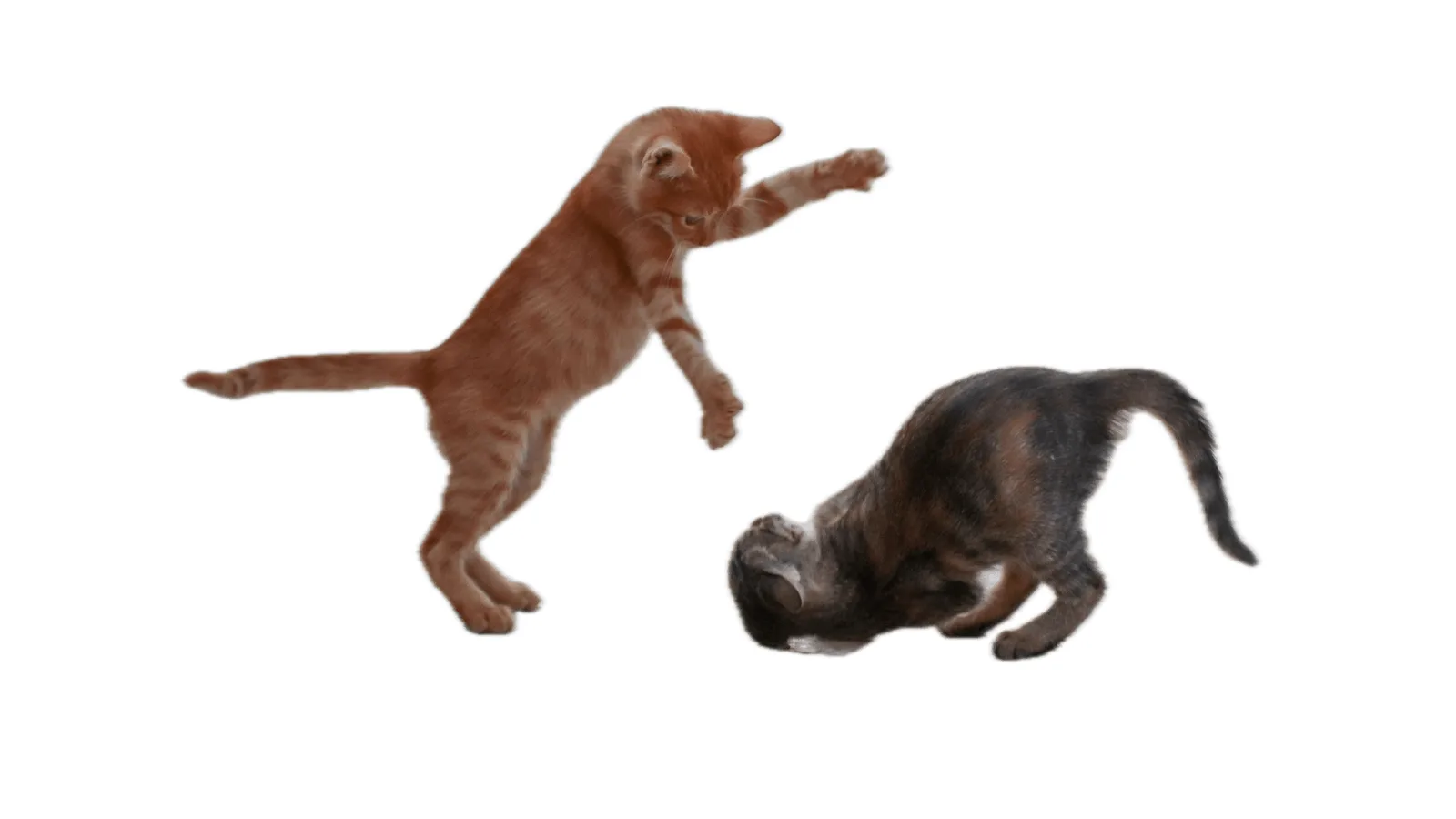
Two kittens in the picture above. The ginger one is mid-leap, claws out. The tabby has its head on the floor. It looks like a fight. It isn't. In ten seconds the tabby leaps and the ginger one rolls over.
Every D&D table plays at fighting. Characters argue, steal from each other, insult the paladin's god. Most of it is play. Some of it is not, and the person on the receiving end usually knows first. This post covers how to tell the two apart, what gamers call the players who cross over, and what the table can do about it.
Play fighting looks like fighting, on purpose
Peter Smith and Michael Boulton studied rough-and-tumble play in children. It "appears superficially similar to fighting," they write, but "differs in terms of causation and intent" [1]. Children can tell the two apart, using several cues. And the same study carries the warning: rough play "can also be used in socially manipulative ways, for example to inflict harm or achieve dominance" [1].
That is the whole problem at a D&D table in one sentence. The in-character insult and the real one use the same words. What differs is why it's said, and whether the other person still wants to play.
Animals send a signal: "I still want to play"
Marc Bekoff filmed dogs, wolf pups and coyote pups at play and timed their play bows, front legs down, rear up. The bows were not random. They clustered right before or after the moves most likely to be misread, above all a bite with a hard side-to-side head shake [2]. The bow says: "I want to play despite what I am going to do or just did" [2].
Tables need the same bow. When your rogue robs the cleric, a grin across the table, a "this is going to be great" out of character, or a quick "you OK with this?" does the bow's job. The bite lands as play because the signal came with it.
Sergio and Vivien Pellis spent decades on play fighting in rats, and found it shapes the brain areas involved in social behaviour [3]. Play fighting is how young mammals learn to be social. It is worth protecting, not banning.
When it stops being play: what bullying is
Dan Olweus, who started the research on school bullying in the 1970s, defines it with three parts: the harm is intentional, it is repeated, and there is an imbalance of power [4]. Olweus insists bullying is kept distinct from general aggression [4]. One heated argument over a loot split is not bullying. The same player targeting the same person every session, when that person can't push back, is.
Power at a table comes in many shapes: the DM's friend, the player who knows the rules best, the loudest voice, the one who's been in the group longest, the only one who owns the books. (And the one who brought the snacks, which is a quieter and more dangerous kind of power.)
What people call mean players
The word gamers use most is griefer. Chek Yang Foo and Elina Koivisto studied it in online role-playing games, where grief play means "a player intentionally disrupts the gaming experience of other players" [5]. They also found players felt griefed by others who did not mean it, and proposed a second word, greed play: disruption that comes from chasing your own win, not from wanting others to suffer [5]. They treat it as a subtler form of griefing [5].
Both show up at the tabletop:
- The griefer. Steals from the party to watch them squirm, kills the NPC another player loves, mocks a character's backstory. The point is the other player's reaction.
- The greed player. Hogs the spotlight, takes every magic item, argues every ruling in their own favour. They aren't out to hurt anyone. Other people's fun still drains away.
- "It's what my character would do." Table slang calls this My Guy syndrome: a player uses the character as cover for behaviour that lands on real people. The character is fiction. The target isn't.
The label matters less than the three Olweus tests. Is it aimed at someone, again and again, who can't answer back [4]?
The rules already have a play fight: the grapple
D&D 2024 has play fighting built in. An Unarmed Strike can be a Grapple instead of damage: the target makes a Strength or Dexterity saving throw against 8 + your Strength modifier + Proficiency Bonus, or has the Grappled condition, Speed 0 [6]. It escapes with an action, a Strength (Athletics) or Dexterity (Acrobatics) check against the same DC [6].
The line that matters: "the grappler can release the target at any time (no action required)" [6]. The kitten on top can always let go. So can the player on top.
A good grapple is like a good hug: both sides should want it, and either side can let go.
Here is a level 1 Fighter (Strength 16, DC 13) grabbing three party members, every d20 result counted:
| Target | Chance to be grabbed | Escape per try | Turns held, if never let go | Still held after 3 tries |
|---|---|---|---|---|
| Wizard (Dex 14, no save proficiency) | 50% | 50% | 2.00 | 12.5% |
| Fighter (Strength save +5, Athletics +5) | 35% | 65% | 1.54 | 4.3% |
| Rogue (Dex save +5, Acrobatics Expertise +7) | 35% | 75% | 1.33 | 1.6% |
The wizard has it twice as hard as anyone. A grapple on the fighter is a contest. A grapple on the wizard is the same move with a power gap under it, and every action the wizard spends escaping is a spell not cast. That is Olweus's third test in dice [4]. Pick on someone your own size, or better, let go.
(The cat stat block, for the record, has one attack, Scratch, for 1 Slashing damage, and no grapple. Kittens run on goodwill.)
What to do about it
- Set the fight rules before the fight. A session zero, covered in our beginner's guide, is where the table agrees whether player-versus-player is in the game at all, and how far it goes.
- Use lines and veils. Ron Edwards's tool: a line is content that does not appear in the game; a veil happens off screen and gets referred to, not played out [7].
- Put an X-Card on the table. John Stavropoulos's tool is an index card with an X on it. Anyone can lift or tap it, and the content gets changed. "You don't have to explain why. It doesn't matter why" [8]. Nobody has to argue with the loudest player to get out of a scene. The TTRPG Safety Toolkit by Kienna Shaw and Lauren Bryant-Monk collects these tools and more, free [7].
- Talk to the player, away from the table. Start with the pattern, not the person: "Your rogue has stolen from Sam three sessions running. Sam's stopped talking. What's going on?" Greed players often don't know [5]. Griefers do, and the conversation tells you which one you have.
- Back the target, out loud. Bullying depends on the power gap [4]. The DM and the rest of the table close it by saying "not at this table."
- If it keeps happening, the player goes. The Olweus test is repetition [4]. A table can survive one bad night. It shouldn't have to survive a pattern.
The short of it
- Play fighting and real fighting look alike and differ in intent [1].
- Animals signal "I still want to play" around the moves most likely to be misread [2]. Tables need the same signal.
- Bullying is intentional, repeated, and uses a power gap [4].
- Griefers disrupt on purpose; greed players do it chasing their own win [5].
- In the 2024 grapple rules, the grappler can always let go [6]. A DC 13 grab holds a wizard twice as long as a rogue.
- Session zero, lines and veils [7], and the X-Card [8] let anyone stop a scene without a fight.
How we got the numbers: every d20 result counted (playing_vs_bullying_maths.py). Grappler: level 1 Fighter, Strength 16, Proficiency Bonus +2, DC 13. Each target uses its better save and better escape skill. "Turns held" assumes the grappler never releases and the target tries every turn.
Table Talk
Tia: The kittens are the whole post. Same claws, same pounce, and both of them want to keep going.
Rohan: Easy to say with kittens. At a real table half the "bullies" are just good at the game and someone's sulking.
Tia: That's greed play, not griefing. Different fix. And Olweus has three tests: on purpose, again and again, someone who can't answer back.
Rohan: Fine. But I'm not running an X-Card at my table. Nobody's pulled one in ten years.
Tia: Then it costs you nothing to put it there. The one night someone needs it, they won't have to explain.
Rohan: My tip: if one player's grabbing the wizard every session, give the wizard Misty Step and watch the problem solve itself.
Tia: Mine: when your character does something mean to another character, give the play bow. Look at the player and grin.
References
- Smith, P. K., & Boulton, M. (1990). Rough-and-tumble play, aggression and dominance: Perception and behaviour in children's encounters. Human Development, 33, 271–282. https://doi.org/10.1159/000276524
- Bekoff, M. (1995). Play signals as punctuation: The structure of social play in canids. Behaviour, 132, 419–429. https://doi.org/10.1163/156853995X00649
- Pellis, S. M., & Pellis, V. C. (2007). Rough-and-tumble play and the development of the social brain. Current Directions in Psychological Science, 16(2), 95–98. https://doi.org/10.1111/j.1467-8721.2007.00483.x
- Olweus, D. (2013). School bullying: Development and some important challenges. Annual Review of Clinical Psychology, 9, 751–780. https://doi.org/10.1146/annurev-clinpsy-050212-185516
- Foo, C. Y., & Koivisto, E. M. I. (2004). Defining grief play in MMORPGs: Player and developer perceptions. Proceedings of the 2004 ACM SIGCHI International Conference on Advances in Computer Entertainment Technology, 245–250. https://doi.org/10.1145/1067343.1067375
- Wizards of the Coast. System Reference Document 5.2.1. 2025. CC-BY-4.0. Sections: "Rules Glossary" (Unarmed Strike, Grappling, Grappled); "Classes" (Fighter, Rogue, Wizard saving throws; Rogue Expertise); "Monsters" (Cat). https://media.dndbeyond.com/compendium-images/srd/5.2/SRD_CC_v5.2.1.pdf
- Shaw, K., & Bryant-Monk, L. TTRPG Safety Toolkit (includes Lines and Veils, from Ron Edwards's Sex and Sorcery, 2003). https://ttrpgsafetytoolkit.com/
- Stavropoulos, J. X-Card: Safety Tools for Simulations and Roleplaying Games. https://docs.google.com/document/d/1SB0jsx34bWHZWbnNIVVuMjhDkrdFGo1_hSC2BWPlI3A/