Psychologists have a name for the story you tell about yourself: narrative identity, "a person's internalized and evolving life story, integrating the reconstructed past and imagined future to provide life with some degree of unity and purpose" [1].
D&D lets you write a draft of that story with training wheels on. You can try out who you might become and walk away from the table if it does not fit.
That, I think, is why it heals. Here is what the research supports, what it does not yet, and how to use it at your table on Friday.
Play Is Not Frivolous
Our culture treats play as the opposite of serious work: something children do before they grow up and get "real" jobs.
This is backwards.
Play is old, and it is everywhere. The ethologist Gordon Burghardt spent a book tracing it across the animal kingdom, from human babies to animals nobody thought of as playful, and argues that playfulness may have been essential to much of what we consider distinctively human and mammalian [2]. Kittens attack yarn. Adults need their yarn too.
Adults need spaces where they can:
- try on different identities
- practise courage without real danger
- feel big emotions at a safe distance
- build friendships through shared problems
- fail without it costing the rent
A game night gives you all five, with snacks.
What Happens at the Table
1. Safe Identity Exploration
When you make a character you are filling out a sheet, and you are also asking yourself questions:
- Who would I be if I were brave?
- Can I be powerful without being cruel?
- Can I be kind without being weak?
A shy player runs a loud paladin and finds out being assertive feels good. An anxious player runs a wild magic sorcerer and survives the chaos. A player questioning their gender tries new pronouns at a table of friends and finds they fit.
The character is a laboratory for the self.
The research on narrative identity points the same way. People whose life stories feature personal agency and exploration, and who find redemptive meaning in hard times, tend to report better mental health and well-being [1]. The same authors are careful to say the causal direction is not yet untangled [1]. A character sheet is a cheap place to practise the agentic version of the story.
2. The Power of "As If"
Adlerian therapists use a technique called acting "as if": a client considers how they would act if they were already the person they want to be, then tries acting that way [3].
D&D builds this in.
Your character has 18 Charisma and walks into the duke's hall like they own it. You, the player, must voice that confidence out loud, to real people, in real time. Pretend or not, you are practising confidence.
The courage your character shows gets a little easier to find on Monday. That is the hope. The honest status is below: participants report it, and the controlled trials have not caught up.
Theory of Mind: Walking in Others' Shoes
Theory of mind is the ability to understand that other people have thoughts, feelings and motives different from yours. A session is a workout for it. You must constantly ask:
- "What would my character think about this?"
- "How does the innkeeper feel right now?"
- "Why did the other player do that?"
- "What does the DM want us to notice?"
You hold several perspectives at once: yours, your character's, the other characters', the NPCs', and the world's own logic.
Does it make you more empathetic? Two findings, neither of them the final word:
- Role-players score higher on empathy. A study of 127 fantasy role-players found they scored significantly higher than a comparison group on a standard empathy scale (the Interpersonal Reactivity Index) [4]. It is a snapshot, though: empathetic people may simply be drawn to the hobby.
- Improv training shifts people. In two experiments, improvisational theatre raised participants' tolerance of uncertainty and their positive mood, and in the second one only the improv group improved, against a control doing scripted social tasks [5]. A D&D session is a lot of improv with dice.
Social Problem-Solving in a Safe Container
Life hands us problems nobody taught us to solve: a friend who crossed a line, a boss asking for something wrong, a family argument at Christmas. We muddle through and sometimes cause real harm.
D&D lets a group rehearse the shape of those problems first.
The party has captured the bandit who burned the mill. Do you:
- hang them?
- let them go?
- make them rebuild the mill?
- hand them to the duke, who may be worse?
There is no right answer. The table must state its values, hear the paladin out, strike a deal and live with it. Nobody actually dies. The bandit might.
The Collaborative Muscle
Most games are competitive. D&D is mostly cooperative. You spend four hours:
- sharing the spotlight
- celebrating when someone else lands the killing blow
- building on others' ideas instead of beating them
In one year-long therapy group run with D&D, participants described more confidence in social situations, "particularly with boundaries or making mistakes", and said they carried the skills into real life [6].
The Healing Power of Story
We Are Storying Animals
We tell stories about ourselves constantly: "I'm someone who...", "I've always been...". Some of those stories limit us:
"I'm not brave."
"I always fail when it matters."
"People like me don't get to be the hero."
D&D Lets You Draft a New One
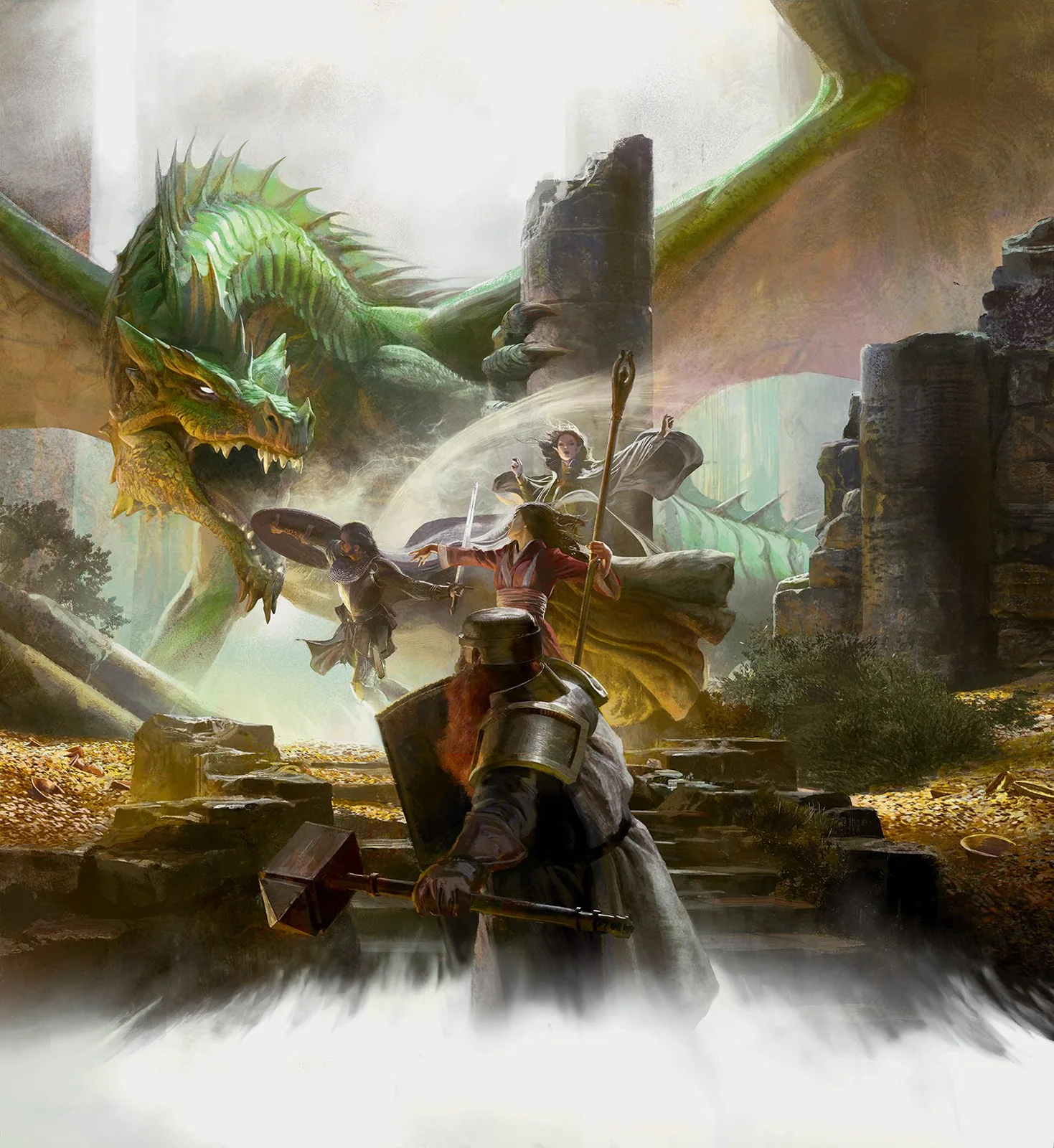
At the table you write a different story: one where you charge the dragon, the dice sometimes love you, and people like you do win.
In one Australian study, thirteen D&D players in recovery from mental health difficulties told researchers what the game did for them. Their themes: experiencing things through characters, building skills, finding space away from their symptoms, safely engaging with their difficulties, and building relationships [7]. Every stage of a standard model of psychological recovery showed up in their stories [7].
The Safe Space Principle
None of this works at a table where people get mocked. Players need to know:
- they will not be laughed at for trying
- failing is part of the game, not a verdict on them
- vulnerability will not be used against them
- they can step back if something feels wrong
Organisational psychologists call this psychological safety: "a shared belief held by members of a team that the team is safe for interpersonal risk taking." In a study of 51 work teams, it went with more learning behaviour [8]. A party is a team.
So table safety is not "political correctness". It is the foundation. Without it, D&D is a game. With it, it can be a practice.
What the Research Actually Shows
The honest version, because you deserve better than "studies show".
| Study | Who | What it found | The catch |
|---|---|---|---|
| Rivers et al., 2016 [4] | 127 fantasy role-players | higher empathy scores than a comparison group | correlation, not cause |
| Felsman et al., 2020 [5] | improv training experiments | more uncertainty tolerance and positive mood | improv, not D&D |
| Abbott et al., 2022 [6] | a year-long D&D therapy group | more social confidence, skills used outside the game | one group, interviews |
| Causo & Quinlan, 2021 [7] | 13 players in mental health recovery | the game mapped onto every stage of recovery | small, qualitative |
| Henrich & Worthington, 2021 [9] | review of 13 studies | no single "D&D player" personality; no link to maladaptive coping; possible benefits | "promising, but preliminary" |
| Arenas et al., 2022 [10] | review of 50 sources on therapeutic RPGs | a potential complementary tool in psychotherapy | only 16% were experiments |
Read the last column. The direction is good and consistent. The evidence is young: small groups, mostly interviews, few controlled trials [9][10]. Anyone who tells you D&D is proven therapy is ahead of the science. Anyone who tells you it is just a game has not read it.
D&D is not therapy. It can be therapeutic. The reviews above see it as a complement to professional care [10], not a replacement.
The Gift Economy of Play
One more thing, and this one is opinion.
A table runs on a gift economy. The DM gives a world. Players give their creativity. Everyone gives attention and laughter. Nobody keeps score of who contributed more.
In a culture that prices everything, a room where the giving is the reward is rare. It trains generosity. That alone would justify the snacks.
Not Just "Escapism"
Critics call D&D "escapism", as if escaping were a crime.
But consider who is escaping:
- a teenager out of a chaotic home, into a world where their choices matter
- a player who is never the hero at work, into a story where they are
- someone grieving, into a world where a friend can come back
- an anxious person, into a world with clear rules and dice to share the blame
That is not escape. It is rehearsal.
Nobody sneers at someone "escaping" to the gym to build their body. Four hours at the table building nerve deserves the same respect.
Take This to Your Table
As a DM:
- Hold a session zero and ask what people want from the game, and what they want kept out.
- Let players sit with hard moments instead of rushing to the next fight.
- Celebrate growth, not just tactics: "your character forgave him" is a highlight.
As a Player:
- Notice what your character choices say about you.
- Pay attention to which moments hit hard. That is data.
- Pick one quality you want more of, and play it.
As a Table:
- Agree how anyone can pause a scene, no questions asked.
- Leave five minutes at the end to talk about what landed.
- Treat play as legitimate. It is.
Self-Assessment: What D&D Gives You
Circle what resonates. No wrong answers.
I come to D&D for:
| Escape | Connection | Challenge | Creativity |
|---|---|---|---|
| Identity Exploration | Laughter | Strategy | Story |
| Belonging | Excitement | Relaxation | Growth |
D&D has helped me:
- Feel more confident speaking up
- Practise saying "no"
- Try on different parts of my personality
- Form friendships I wouldn't have otherwise
- Feel less alone
- Handle conflict more calmly
- Think more creatively
- Feel proud of something I did
- Laugh more
- Find a community that accepts me
The character trait I most explore through D&D is:
The character trait I'm learning to use in my real life is:
There's no score. Just awareness. Noticing what the game gives you makes it easier to take more of it home.
The Deeper Truth
You do not need to know any of this for it to work. Sit down wanting to fight goblins and roll dice, and the table does the rest.
Play is our native language. D&D is play with a rulebook.
Start rolling, or take your dice to the 3D table.
Table Talk
Tia: Why does a shy player pick the loudest paladin at the table? Because the sheet is a safe place to practise the story they want.
James: Or they just wanted to yell at a dragon.
Tia: Same thing. The yelling is the practice.
James: Careful. You'll have people saying D&D is therapy.
Tia: It isn't. The reviews call the evidence promising but preliminary. Therapeutic, not therapy.
James: Good, because no therapist lets you roll to persuade them.
Tia: The part I'd bet on is safety. Nobody takes a risk at a table where people get mocked.
James: That's why I laugh at my natural 1s first. Then nobody else has to.
Tia: Tip for your next session: agree how anyone can pause a scene, and keep five minutes at the end to talk about what landed.
References
- McAdams, D. P., & McLean, K. C. (2013). Narrative identity. Current Directions in Psychological Science, 22(3), 233–238. https://doi.org/10.1177/0963721413475622
- Burghardt, G. M. (2005). The Genesis of Animal Play: Testing the Limits. MIT Press. https://doi.org/10.7551/mitpress/3229.001.0001
- Watts, R. E. (2003). Reflecting "as if": An integrative process in couples counseling. The Family Journal, 11(1), 73–75. https://doi.org/10.1177/1066480702238817
- Rivers, A., Wickramasekera, I. E., II, Pekala, R. J., & Rivers, J. A. (2016). Empathic features and absorption in fantasy role-playing. American Journal of Clinical Hypnosis, 58(3), 286–294. https://doi.org/10.1080/00029157.2015.1103696
- Felsman, P., Gunawardena, S., & Seifert, C. M. (2020). Improv experience promotes divergent thinking, uncertainty tolerance, and affective well-being. Thinking Skills and Creativity, 35, 100632. https://doi.org/10.1016/j.tsc.2020.100632
- Abbott, M. S., Stauss, K. A., & Burnett, A. F. (2022). Table-top role-playing games as a therapeutic intervention with adults to increase social connectedness. Social Work with Groups, 45(1), 16–31. https://doi.org/10.1080/01609513.2021.1932014
- Causo, F., & Quinlan, E. (2021). Defeating dragons and demons: Consumers' perspectives on mental health recovery in role-playing games. Australian Psychologist, 56(3), 256–267. https://doi.org/10.1080/00050067.2021.1890983
- Edmondson, A. C. (1999). Psychological safety and learning behavior in work teams. Administrative Science Quarterly, 44(2), 350–383. https://doi.org/10.2307/2666999
- Henrich, S., & Worthington, R. (2021). Let your clients fight dragons: A rapid evidence assessment regarding the therapeutic utility of "Dungeons & Dragons". Journal of Creativity in Mental Health, 18(3), 383–401. https://doi.org/10.1080/15401383.2021.1987367
- Arenas, D. L., Viduani, A. C., & Araujo, R. B. (2022). Therapeutic use of role-playing game (RPG) in mental health: A scoping review. Simulation & Gaming, 53(3), 285–311. https://doi.org/10.1177/10468781211073720