A cloaked figure stands alone on still water under a full moon. Nobody is fighting yet. Everything is about to happen.
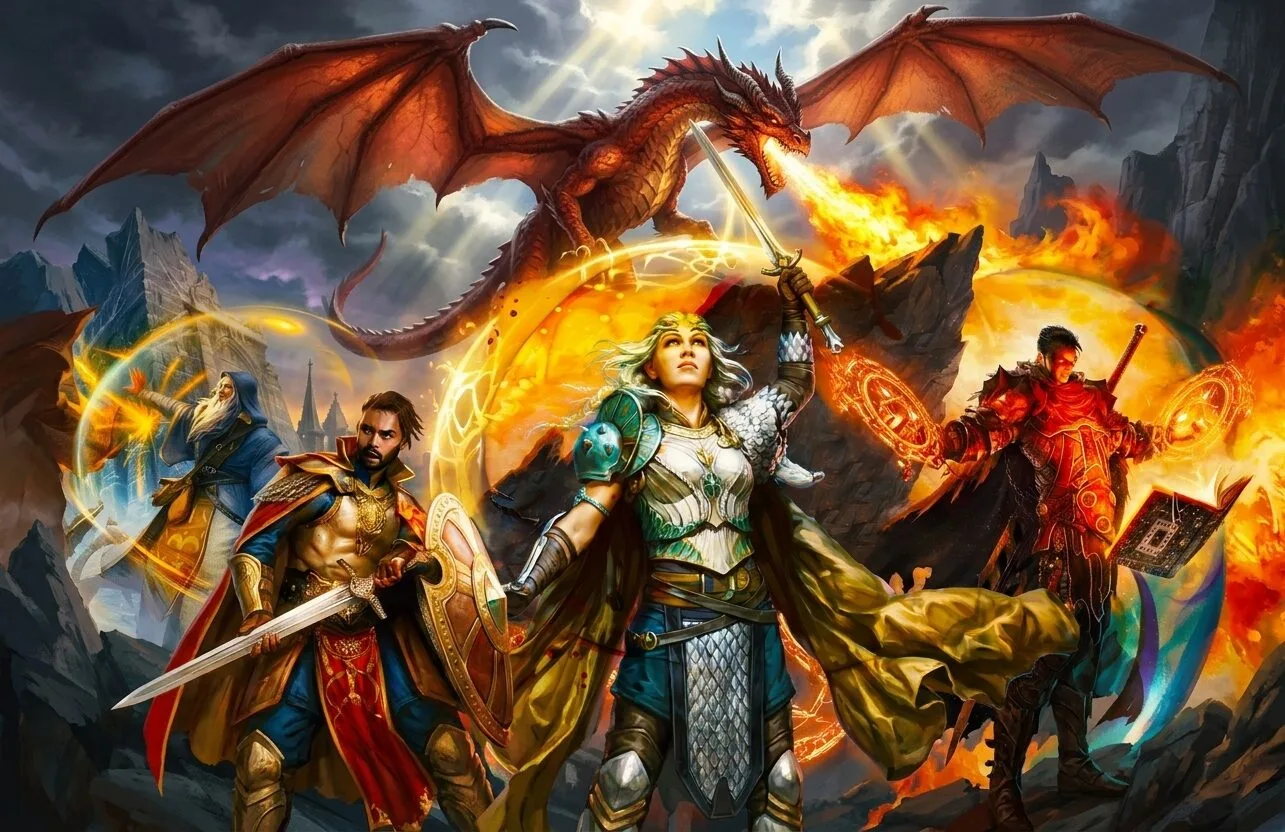
Every table knows the scene that follows. The dragon lands, the party stands its ground, and one player picks up the d20 while everyone else stops breathing. We showed that picture, a green dragon over a party of four, on Why D&D Heals. This post asks why it lands so hard.
Tia brings the brain and the philosophy: dopamine, and a psychiatrist who wrote a textbook about death. Arthur brings the numbers: which roll gives you the most suspense, and how to set it.
What makes a hero, according to people
Before the brain chemistry, a plain question. What do people mean by "hero"?
Elaine Kinsella and colleagues asked. Participants wrote open descriptions of heroes, coders sorted them into 26 categories, and later participants rated which features sit at the centre. Brave and moral integrity came out central. Humble and proactive came out peripheral [1]. People also spotted central features faster and remembered them better [1].
The same team then asked what heroes are for. Three answers held up: heroes enhance the lives of others, model morals, and protect people from threats. Thinking about a hero, rather than a leader or an acquaintance, while under psychological threat met all three needs [2].
Look at the dragon scene with that list in hand. Bravery: a person walks towards the thing that kills people. Moral integrity: they do it for somebody else. Protection: the village is behind them. The scene is the hero prototype drawn in paint.
Philip Zimbardo's group adds one hard edge. Their definition of heroism includes accepting physical peril or social sacrifice [3]. No risk, no hero. That is why a fight the party can't lose feels hollow, and why the dice matter.
Meddle not in the affairs of dragons, for you are crunchy and taste good with ketchup.
Dopamine: the chemistry of "maybe"
Now the brain.
Dopamine is the teacher, not the prize. Wolfram Schultz, Peter Dayan and Read Montague showed that dopamine neurons in primates signal the error in a prediction of reward: better than expected, they fire; exactly as expected, they stay flat; worse than expected, they dip [4]. A sure thing teaches nothing, so it barely registers.
Dopamine also tracks uncertainty. In a 2003 follow-up, Christopher Fiorillo, Philippe Tobler and Schultz found a second, slower dopamine response that grew with uncertainty and ramped up until the moment the reward might arrive. Uncertainty is highest at a probability of 0.5 [5].
Read that again with a d20 in your hand. A slow build that peaks when the odds are a coin flip, and lasts until the result comes in. That is the half-second the die spends tumbling. (And the reason nobody breathes until it stops, face up, behind the pizza box.)
People release it when they play. Matthias Koepp's team scanned people with PET while they played a video game. Dopamine release in the striatum rose during play, most in the ventral striatum, and the rise tracked how well each player performed [6].
A fair caution from Tia: those are monkeys watching signal lights and people playing a video game in a scanner. Nobody has put a D&D table in a PET scanner. The mechanism fits; the table study doesn't exist yet.
Arthur's numbers: where the suspense peaks
If uncertainty peaks at 50%, we can find the most suspenseful roll on a d20. Uncertainty here is the variance of a pass/fail roll, p × (1 − p): zero for a sure thing, 0.25 at a coin flip.
| You need | Chance | Uncertainty p(1−p) | With Heroic Inspiration |
|---|---|---|---|
| 2+ | 95% | 0.048 | 99.8% |
| 6+ | 75% | 0.188 | 93.8% |
| 10+ | 55% | 0.248 | 79.8% |
| 11+ | 50% | 0.250 | 75.0% |
| 12+ | 45% | 0.248 | 69.8% |
| 16+ | 25% | 0.188 | 43.8% |
| 20 | 5% | 0.048 | 9.8% |
Three things fall out of the table.
The peak is flat on top. Anything from needing 8+ to needing 14+ keeps uncertainty above 0.22, nearly the maximum. You don't have to hit 50% on the nose.
The easy and the impossible feel the same. Needing 2+ and needing a natural 20 carry identical uncertainty (0.048). One is a formality and the other is a lottery ticket. Neither is a hero moment.
The DM can set the peak on purpose. To make a roll a coin flip, set the DC at 11 plus the character's modifier. A fighter with +5 to Athletics climbing the collapsing tower: DC 16. A wizard with +7 on the Arcana check that seals the portal: DC 18. Now the whole table watches the die.
Heroic Inspiration, the hero's reroll
The 2024 rules turn heroics into a mechanic. If you have Heroic Inspiration, you can spend it to reroll any die immediately after rolling it, and you must use the new roll. The GM typically awards it "when you do something particularly heroic, in character, or entertaining", and you can never hold more than one. Human characters start each day with it [7].
The last column of the table shows what it does: a 50% roll becomes 75%. That moves you off the peak of uncertainty. Arthur's advice: save it for the roll that decides the scene, and you get the tension of the first roll and a second chance.
In a session of 20 d20 rolls, the chance of at least one natural 20 is 64%. Over 50 rolls, 92%. The big moment is coming. Heroic Inspiration makes sure it is yours.
Meaning: Yalom's four big worries, and the dragon
Dopamine explains the rush. It doesn't explain why people still talk about a fight from years ago.
Irvin Yalom, a Stanford psychiatrist, built a whole school of therapy on four "ultimate concerns" every person must face: death, freedom, isolation and meaninglessness [8]. We spend a lot of life not looking at them. Tia's point: the dragon scene makes you look at all four, safely, in one evening.
Death. The dragon can kill your character. A character you built, named and grew for months. The 2024 rules keep that real: three failed Death Saving Throws and the character dies [7]. Yalom argues that facing death, rather than hiding from it, is what makes a life feel urgent and real [8]. At the table you rehearse that at the cost of a character sheet.
Freedom. Nobody makes you charge. You choose to, and you own the choice. Yalom treats freedom as a weight as much as a gift: if we choose, we are responsible [8]. "I cast Fireball on the bridge" is a choice with your name on it.
Isolation. Yalom writes that each of us is, in the end, alone in our own experience [8]. The party is the answer the game gives. Four people stand together in front of the dragon. The dragon picture on Why D&D Heals shows four heroes, not one.
Meaninglessness. Why does any of it matter? The game hands you a reason, the village, and then lets you decide it was worth it. That is Yalom's own prescription in miniature: meaning comes from engagement, not from finding the answer written somewhere [8].
Why it feels good to play, and when it doesn't
Andrew Przybylski, Scott Rigby and Richard Ryan argue that games appeal, and help well-being, when they meet three needs: competence, autonomy and relatedness [9]. The hero moment hits all three at once: you might win (competence), you chose to be here (autonomy), and your friends are watching (relatedness).
It goes wrong when one of the three is missing.
- No competence: the DC is 25 for a character with +2. The roll is a 0% shot dressed as a hero moment.
- No autonomy: the DM has already decided the dragon flees. The players feel it.
- No relatedness: one player gets every big roll, every session. The rest are an audience.
Tia's fix for the last one is the simplest thing in this post: before the finale, ask each player which roll they want to be theirs.
How to build a hero moment at your table
- Put a real risk on the table. Heroism needs peril [3]. Say out loud what happens on a fail.
- Set the DC at 11 + modifier for the roll that decides the scene. Use the table above.
- Give out Heroic Inspiration for bravery, not just good jokes. The rules allow it [7].
- Let the choice be theirs. Offer the retreat, then respect the charge.
- Stop the table before the roll. Everyone watches. The ramp in dopamine lasts until the result [5]; don't waste it rolling in the background.
Try step 2 now on the main roller: roll 1d20+5 against 16 twenty times and count. You should land near ten.
If the dragon in your finale is a green one, the Adult Green Dragon stat block is on the site.
How we got the numbers: exact enumeration of a single d20 (work shown in the table). Heroic Inspiration modelled as one reroll, used only on a failed first roll. Natural 20 odds: 1 − (19/20)^n.
Table Talk
Arthur: The whole post, in one line: set the DC at 11 plus the modifier. Coin flip, maximum suspense.
Tia: That gets you the rush. It doesn't get you the story they tell in ten years. That's the meaning part.
Arthur: Meaning follows the rush. Nobody remembers the fight they were always going to win.
Tia: And nobody remembers a coin flip they didn't care about. The village has to matter first.
Arthur: Fine. Both. My tip: write "11 + mod" on your DM screen and use it for the one roll per session that decides things.
Tia: Mine: when a player does something brave, hand them Heroic Inspiration on the spot and say why. You're telling them what a hero looks like at your table.
Arthur: Then they spend it on a Perception check.
Tia: Then that was their hero moment. Let them have it.
References
- Kinsella, E. L., Ritchie, T. D., & Igou, E. R. (2015). Zeroing in on heroes: A prototype analysis of hero features. Journal of Personality and Social Psychology, 108(1), 114–127. https://doi.org/10.1037/a0038463
- Kinsella, E. L., Ritchie, T. D., & Igou, E. R. (2015). Lay perspectives on the social and psychological functions of heroes. Frontiers in Psychology, 6, 130. https://doi.org/10.3389/fpsyg.2015.00130
- Franco, Z. E., Blau, K., & Zimbardo, P. G. (2011). Heroism: A conceptual analysis and differentiation between heroic action and altruism. Review of General Psychology, 15(2), 99–113. https://doi.org/10.1037/a0022672
- Schultz, W., Dayan, P., & Montague, P. R. (1997). A neural substrate of prediction and reward. Science, 275(5306), 1593–1599. https://doi.org/10.1126/science.275.5306.1593
- Fiorillo, C. D., Tobler, P. N., & Schultz, W. (2003). Discrete coding of reward probability and uncertainty by dopamine neurons. Science, 299(5614), 1898–1902. https://doi.org/10.1126/science.1077349
- Koepp, M. J., Gunn, R. N., Lawrence, A. D., Cunningham, V. J., Dagher, A., Jones, T., Brooks, D. J., Bench, C. J., & Grasby, P. M. (1998). Evidence for striatal dopamine release during a video game. Nature, 393, 266–268. https://doi.org/10.1038/30498
- Wizards of the Coast. System Reference Document 5.2.1. 2025. CC-BY-4.0. Sections: "Playing the Game" (Heroic Inspiration; Death Saving Throws); "Rules Glossary" (Heroic Inspiration). https://media.dndbeyond.com/compendium-images/srd/5.2/SRD_CC_v5.2.1.pdf
- Yalom, I. D. (1980). Existential Psychotherapy. New York: Basic Books. ISBN 978-0-465-02147-5.
- Przybylski, A. K., Rigby, C. S., & Ryan, R. M. (2010). A motivational model of video game engagement. Review of General Psychology, 14(2), 154–166. https://doi.org/10.1037/a0019440