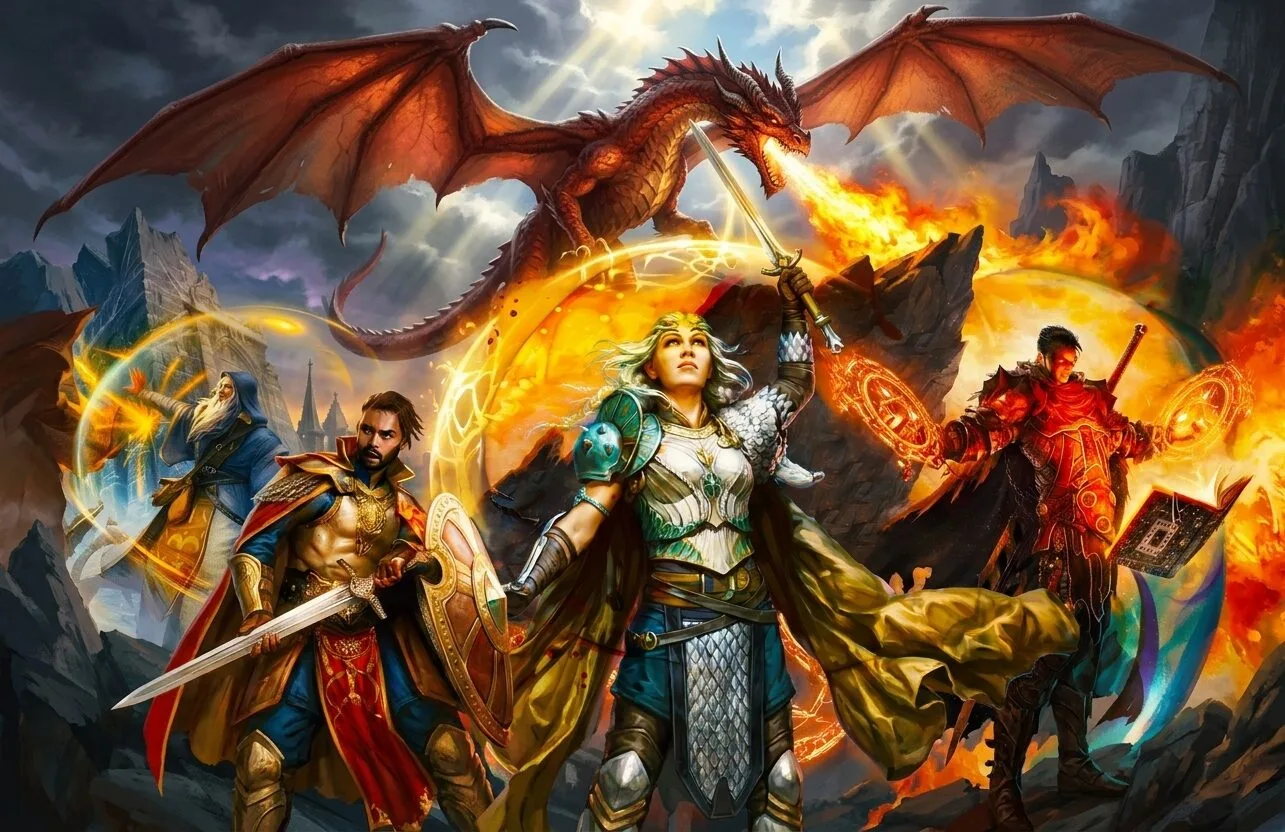
The most famous sword in fantasy comes out of a lake, held up by a woman's arm.
In Thomas Malory's Le Morte d'Arthur, Arthur has just broken his sword in a fight and spent three days healing his wounds. Merlin takes him to a lake, "and in the midst of the lake Arthur was ware of an arm clothed in white samite, that held a fair sword in that hand" [1]. The Lady of the Lake does not fight anyone. The Lady gives, for a gift to be named later. And a few lines later Merlin asks Arthur which he prefers, the sword or the scabbard. Arthur picks the sword. Merlin calls him unwise: "the scabbard is worth ten of the swords, for whiles ye have the scabbard upon you, ye shall never lose no blood" [1].
That is the feminine side of heroism in one scene. It is the power that keeps you alive, and the story knows it is worth ten times the one that cuts.
Always be kind to the cleric. The cleric decides who gets back up.
This post is about playing that side well, and about why it belongs to every character at the table, not only the ones with long hair.
What "feminine" means, according to the people who measure it
In 1974 the psychologist Sandra Bem built a questionnaire, the Bem Sex Role Inventory, that did something new. It scored masculinity and femininity as two separate scales, not two ends of one line [2].
Until then, psychology treated a person as either masculine or feminine, but not both. Bem found the two dimensions are "empirically as well as logically independent" [2]. A person can score high on both: assertive and yielding, instrumental and expressive, depending on what the moment needs. Bem called that androgynous, and argued that strongly sex-typed people "might be seriously limited in the range of behaviors available to them" [2].
The traits on the feminine scale are the ones this post is about: warm, gentle, compassionate, eager to soothe hurt feelings. The masculine scale holds the others: assertive, willing to take a stand, acts as a leader.
Two more findings sit underneath that:
- Men and women are similar on most psychological measures. Janet Hyde reviewed 46 meta-analyses and found males and females "similar on most, but not all, psychological variables" [3]. The differences are real in places and small in most.
- Brains are mosaics. Daphna Joel's team scanned more than 1,400 brains and found each one a mix of features, some more common in females, some in males, some common in both. Human brains "cannot be categorized into two distinct classes: male brain/female brain" [4].
So when we say "feminine character", we mean a character who leads with the feminine-scale traits. Not a character of a particular sex. Everyone at the table carries both scales.
The rules don't care, and that is the point
We searched the full text of the 2024 System Reference Document, all 364 pages, for "gender", "sex", "male", "female", "woman" and "women". Zero hits [5]. No species, class, background or feat changes a number based on who your character is.
That leaves the choice to you. A half-orc barbarian can be the gentlest person at the table. An elf in white samite can be the one who throws the first punch. The rules hand you both scales and let you set the dials.
The angel who smites and heals in one turn
The 2024 rules have an angel, and its stat block makes the argument better than any essay.
The Deva is a Medium Celestial with 229 Hit Points [5]. On its turn it makes two Holy Mace attacks, each dealing 1d6 + 4 Bludgeoning plus 4d8 Radiant damage. Then, as a Bonus Action, it can use Divine Aid (twice a day) to cast Cure Wounds, Lesser Restoration or Remove Curse [5].
We worked out one full turn exactly, every die enumerated:
| Target's AC | Deva hits | Damage from two maces (average) | Healing from Cure Wounds (average) |
|---|---|---|---|
| 13 | 80% | 43.0 | 14.0 |
| 15 | 70% | 37.9 | 14.0 |
| 16 | 65% | 35.3 | 14.0 |
| 18 | 55% | 30.2 | 14.0 |
Holy Mace +8 to hit; a natural 1 misses, a natural 20 is a Critical Hit and doubles the dice. Cure Wounds in 2024 heals 2d8 plus the spellcasting modifier; the Deva's Charisma gives +5 [5].
The angel does not choose between fierce and tender. It does both, in the same six seconds, and the rules built it that way. The heal costs a Bonus Action. The smite costs an Action. Nothing stops one creature from doing both.
What the gentle action is actually worth
Players undersell the soft moves because they don't show up as damage. Here is what they do.
Healing Word saves lives at range. An ally at 0 Hit Points with nobody helping rolls death saves alone, and dies 40.5% of the time (exact, from the SRD's death saving throw rules). Healing Word costs a Bonus Action, works from 60 feet, and restores 2d4 plus your modifier: 8 Hit Points on average for a level 1 cleric with Wisdom 16 [5]. That 40.5% goes to zero, and the ally gets their turn back. (Their first words are rarely "thank you". They are usually "did I miss anything?")
Sanctuary makes the enemy look away. A creature that targets the warded ally with an attack must succeed on a Wisdom saving throw or pick a new target or lose the attack [5]. A level 1 cleric's save DC is 13. A monster with Wisdom +0 fails that save 60% of the time. Three attacks in five just don't happen.
That is Merlin's scabbard in 2024 rules. Keep a friend from bleeding, and you have done more than most sword swings.
Playing a feminine-led character well
Some table-tested ways to lead with the feminine scale without turning your character into a healing vending machine:
- Warmth with a spine. Bem's point was range. Give your gentle character one thing they will not bend on. The kindest cleric in the party refusing to heal the prisoner-torturer is a stronger scene than any fireball.
- Soothe out loud. "Eager to soothe hurt feelings" is on the scale [2]. Your character can calm the frightened villager, talk down the angry party member, or notice the quiet player's character hasn't spoken in an hour. It's roleplay the DM can reward with Advantage on a Persuasion check.
- Give, like the Lady. Carry the potion for someone else. Hand over the magic item you found. Giving creates debts, and debts create story.
- Protect the person, not the objective. Sanctuary, the Help action, standing in the doorway. The scene where your character chooses a friend over the treasure is the one the table remembers.
- Let the other scale show. The gentlest characters get their best moments when they finally take a stand. Save that moment. It lands harder because nobody saw it coming.
Who gets to play it
Everyone. Researchers who study online games found men who play female avatars don't necessarily hide their offline gender; they tend to reinforce idealised feminine appearance and communication, while their movement in the game world looks the same as men who don't switch [6]. The researchers concluded that choosing an avatar's gender "may be less a matter of identity expression, and more a strategic selection" of the codes available [6].
At a D&D table that means the choice is a tool. Pick up the gentle one. See how it feels. Tia wrote in The Psychology of Play: Why D&D Heals that a character is a laboratory for the self, and the feminine scale is one of the cheapest experiments you can run.
The partner post, Fierce Feminine, covers the characters who roar at the dragon. Same dials, turned the other way.
The short of it
- Masculine and feminine traits are two separate scales, and people score on both [2].
- Men and women are similar on most psychological measures [3]; brains are mosaics [4].
- The 2024 SRD never mentions gender. The dials are yours [5].
- The Deva smites for 30 to 43 and heals for 14 in one turn. Tender and fierce, same creature.
- Healing Word takes a downed ally's death chance from 40.5% to zero. Sanctuary wipes out 60% of attacks aimed at a friend.
How we got the numbers: exact enumeration of every die. Deva from the SRD 5.2.1 stat block. Level 1 cleric, Wisdom 16, proficiency +2, save DC 13. Death saves from the SRD rules: 10 or higher succeeds, a 1 counts as two failures, a 20 restores 1 Hit Point.
Table Talk
Tia: The Lady of the Lake is the most powerful person in that scene. Arthur has no sword until the Lady says so.
James: I always thought the Lady was a plot device. Arm comes out, sword appears, done.
Tia: Read the next page. Merlin tells Arthur the scabbard is worth ten swords. The story says protection beats damage.
James: Tell that to my rogue. Sneak Attack is my whole personality.
Tia: And who picked you up last session when you went down in the crypt?
James: Fine. The cleric. My tip: if you play the healer, give them one line they won't cross. It makes every heal a choice.
Tia: Mine: Sanctuary on the friend the brute is staring at. Against Wisdom +0, three swings in five never land.
References
- Malory, T. (1485). Le Morte d'Arthur, Book I, Chapter XXV: "How Arthur by the mean of Merlin gat Excalibur his sword of the Lady of the Lake". Project Gutenberg edition. https://www.gutenberg.org/ebooks/1251
- Bem, S. L. (1974). The measurement of psychological androgyny. Journal of Consulting and Clinical Psychology, 42(2), 155–162. https://doi.org/10.1037/h0036215
- Hyde, J. S. (2005). The gender similarities hypothesis. American Psychologist, 60(6), 581–592. https://doi.org/10.1037/0003-066X.60.6.581
- Joel, D., Berman, Z., Tavor, I., Wexler, N., Gaber, O., Stein, Y., et al. (2015). Sex beyond the genitalia: The human brain mosaic. Proceedings of the National Academy of Sciences, 112(50), 15468–15473. https://doi.org/10.1073/pnas.1509654112
- Wizards of the Coast. System Reference Document 5.2.1. 2025. CC-BY-4.0. Sections: "Rules Glossary" (Death Saving Throws; Help; Bonus Action); "Spells" (Cure Wounds; Healing Word; Sanctuary); "Classes" (Cleric); "Monsters" (Deva). https://media.dndbeyond.com/compendium-images/srd/5.2/SRD_CC_v5.2.1.pdf
- Martey, R. M., Stromer-Galley, J., Banks, J., Wu, J., & Consalvo, M. (2014). The strategic female: Gender-switching and player behavior in online games. Information, Communication & Society, 17(3), 286–300. https://doi.org/10.1080/1369118X.2013.874493