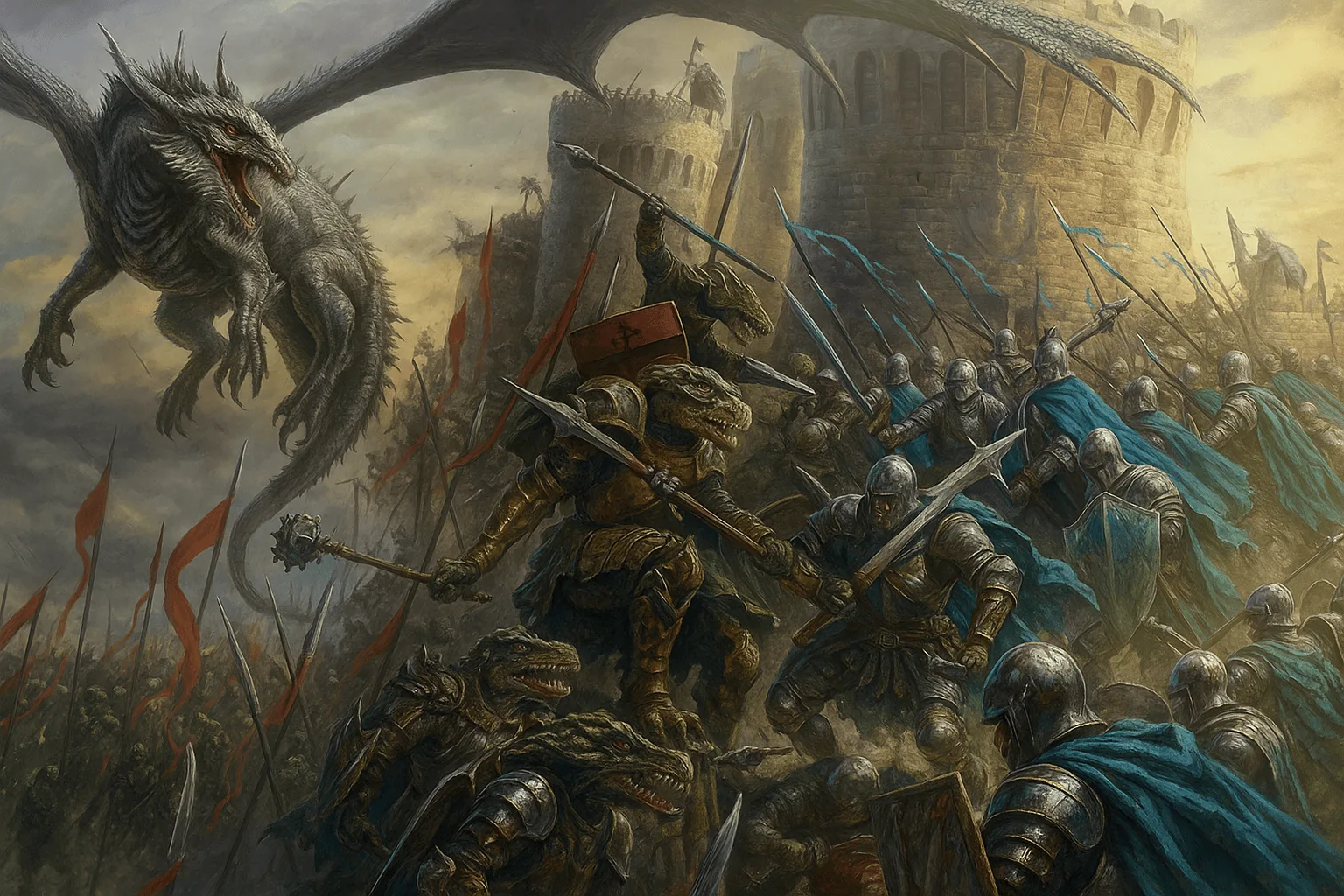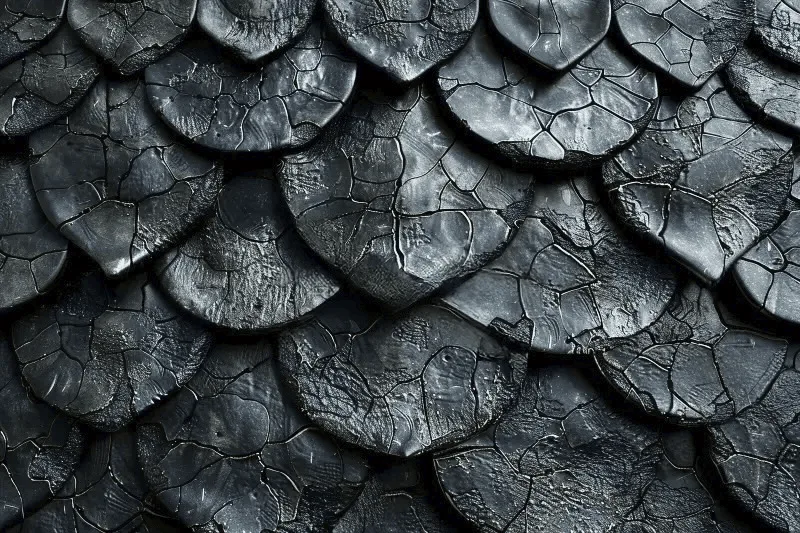
Look at the picture at the top of this page. It is a dragon, or a hand's width of one. Every scale is the size of a shield, every crack as long as your arm, and you can't see where it ends.
That is how a Gargantuan dragon looks from the ground. You don't see the monster. You see its hide.
This post is about that feeling: small, next to something so big you can only take it in one patch at a time. Tia brings the psychology of feeling small. James brings the halfling who hides behind the fighter and wins the fight anyway.
How big "huge" is, in squares
The 2024 rules give every creature a size, and every size a space on the battle map [1]:
| Size | Space | Squares on the map |
|---|---|---|
| Tiny | 2½ by 2½ feet | 4 per square |
| Small | 5 by 5 feet | 1 |
| Medium | 5 by 5 feet | 1 |
| Large | 10 by 10 feet | 4 (2 by 2) |
| Huge | 15 by 15 feet | 9 (3 by 3) |
| Gargantuan | 20 by 20 feet | 16 (4 by 4) |
An Ancient Red Dragon is Gargantuan. It fills 16 squares, the space of sixteen human fighters, or 64 Tiny creatures. It has 507 Hit Points, Armor Class 22 and a Passive Perception of 26 [1].
A 5th-level fighter with Constitution 14 and fixed Hit Points has 44 [1]. The dragon has more than eleven fighters' worth.
The game doesn't hide this from you. It puts the numbers on the table so you feel them.
What feeling small does to you
Psychologists call the emotion you get in front of something vast awe. Dacher Keltner and Jonathan Haidt defined it by two parts: vastness, and a need to rework how you understand the world to fit the vast thing in [2].
The surprise is what awe does to the self. In five studies with 2,078 people, Paul Piff and colleagues found awe produced a "small self": people felt less important, and then acted more generously and more ethically. In one study, people who stood in a grove of towering trees helped more and felt less entitled than people in a control condition [3].
Yang Bai and colleagues then measured the small self directly, across six studies with 2,137 people in collectivist and individualistic cultures. Awe, and not other positive emotions, shrank the self people reported, and that smaller self went with more engagement with the group around them [4].
So feeling small is not a failure. It turns you toward the people beside you.
The frightening kind
There is a catch, and the dragon is it. Amie Gordon and colleagues found a darker variant: threat-based awe, the awe of tornadoes, attacks and wrathful gods. People feel it regularly. It differs from the pleasant kind in appraisal, body and outcome, and it goes with lower well-being. Feeling powerless explains part of that link [5].
Two kinds of small, then:
- Awe-small: "I am one part of something big." You reach for the group.
- Threat-small: "I can do nothing." You freeze.
A dragon hands you the second kind. The game's job, and a good table's job, is to turn it into the first.
The rules were built for small creatures
Read the 2024 rules with a halfling's eyes and they are full of doors for the little ones.
Moving through. You can pass through the space of a creature two sizes larger or smaller than you [1]. A Medium human can run straight through the space of a Huge Adult Red Dragon. Halfling Nimbleness closes the gap for the smallest: a halfling can move through the space of any creature a size larger than itself, but can't stop there [1].
Hiding behind a friend. Halflings are Naturally Stealthy: they can take the Hide action "even when you are obscured only by a creature that is at least one size larger than you" [1]. The fighter's back is cover.
Courage. Halflings are Brave: Advantage on saving throws to avoid or end the Frightened condition [1]. That matters, because Frightened is threat-small in rules form: Disadvantage on checks and attacks while the source is in sight, and you can't willingly move closer to it [1].
Luck. When a halfling rolls a 1 on a D20 Test, it rerolls and must use the new roll [1].
The smallest folk in the book get to walk under dragons, hide behind friends and shrug off fear. That is a design statement.
The odds of hiding from a dragon
Hiding in 2024 is a DC 15 Dexterity (Stealth) check while Heavily Obscured or behind Three-Quarters or Total Cover, out of any enemy's line of sight. Succeed and you have the Invisible condition, and your check total becomes the DC for anyone trying to find you with a Wisdom (Perception) check [1]. Invisible means attacks against you have Disadvantage and yours have Advantage [1].
We computed it exactly. A 5th-level Halfling Rogue with Dexterity 18 and Expertise in Stealth (Rogues pick it at level 1 [1]) rolls +10. The fighter beside it wears Chain Mail, which imposes Disadvantage on Stealth [1], with Dexterity 14 and no proficiency: +2. A dragon's Perception bonus is its Passive Perception minus 10.
| Who hides | Chance to hide (DC 15) | Young Red finds you (+8) | Adult Red (+13) | Ancient Red (+16) |
|---|---|---|---|---|
| Halfling Rogue, +10 | 80% | 33% | 57% | 72% |
| Same, with Luck | 84% | 33% | 57% | 72% |
| Same, with a friend's Help | 96% | 24% | 49% | 63% |
| Fighter in Chain Mail, +2 with Disadvantage | 16% | 59% | 84% | 96% |
| Same, with a friend's Help | 40% | 52% | 78% | 91% |
"Finds you" is the chance one Search succeeds, given you hid. Every figure is exact, from enumerating every d20 roll.
Three things jump out.
- The halfling hides four times in five. Against an Ancient Red Dragon, it still survives a Search 28% of the time. Small is a stat.
- The Help action is worth more than Luck. Luck adds 4 points to the rogue's hide chance. A friend's Help adds 16, and it lowers the dragon's odds of finding you, because Advantage pushes your total up. Help lets an ally give Advantage on a check with a skill the ally is proficient in [1].
- Help rescues the fighter. Advantage and Disadvantage cancel out [1], so the Chain Mail fighter goes from 16% to 40%. A little help from the rogue more than doubles the big one's chance.
The smallest action in the game, one friend saying "I've got you", moves the numbers more than the fancy trait.
Why the little things count
Karl Weick, an organisational psychologist, wrote in 1984 that people freeze when a problem is framed at its full, massive scale. His answer was small wins: "a concrete, complete, implemented outcome of moderate importance". A string of them builds a pattern that attracts allies and lowers resistance to the next one [6].
That is how a party beats 507 Hit Points. Nobody deals 507. The rogue hides. The cleric keeps someone standing. The wizard makes the dragon miss once. The fighter takes a claw so the halfling doesn't. Each is a small win, and the dragon falls to the pattern.
It is also how people get through the dragons outside the game: the debt, the diagnosis, the court date. You won't see the whole hide at once. You can do the next square.
How to run it at your table
For DMs:
- Show the hide, not the dragon. Describe one patch: scales like shields, a crack you could fit a hand in, heat rising off it. Let the players feel how little of it they can see.
- Offer threat-small, then a way out. When the Frightened condition lands, name the cause, then point at something small the character can still do. Powerlessness drives the bad kind of awe [5]. A clear next action takes it away.
- Reward the small action out loud. When the halfling's Help turns a 16% into a 40%, say so. Put the small win in the story.
For players:
- Take the Help action more. One action buys a friend Advantage [1].
- Hide behind your friends. A halfling can Hide with only a Medium ally between it and the enemy [1].
- Pick one square. When the fight looks hopeless, ask the DM, "What is one thing my character can do that matters right now?"
Tia wrote about the other half of the dragon, the anger it stirs up, in The Dragon's Roar. Roar first, then hide, or the other way round.
The short of it
- A Gargantuan dragon fills 16 squares; you fill one [1].
- Awe makes the self feel small and turns people towards each other [3][4]. Threat makes it feel small and powerless [5].
- The 2024 rules give small creatures real tools: move through, hide behind, shrug off fear [1].
- A Halfling Rogue hides from a dragon 80% of the time; a friend's Help makes it 96%.
- Big problems fall to small wins [6].
Roll the Hide check yourself on the main roller: roll 2d20, drop lowest 1, plus 10: the halfling with a friend's Help. See how often you clear 15.
How we got the numbers: exact enumeration of every d20 roll. Level 5 characters, proficiency +3. Halfling Rogue Dexterity 18 with Expertise (+10). Fighter Dexterity 14, no Stealth proficiency, Chain Mail (Disadvantage). Luck modelled on straight rolls only. Dragons from the SRD 5.2.1 stat blocks: Young Red Passive Perception 18, Adult Red 23, Ancient Red 26. One Search by the dragon.
Table Talk
Tia: The point of a Gargantuan dragon is to make you feel small. The point of a party is to make small bearable.
James: I just like that my halfling can run between its legs. Nine squares of Adult Red and I'm in all of them for a second.
Tia: That is the good kind of small. "I'm part of something big." The bad kind is "I can't do anything".
James: But the bad kind is the fun bit. I want to be scared. Why fix it?
Tia: Scared is fine. Powerless is what hurts people. Give them one thing to do and scared becomes brave.
James: Fine. My tip: take the Help action. It beat my Luck by twelve points and nobody ever takes it.
Tia: Mine: when the dragon lands, describe one scale. Don't describe the whole dragon. Nobody can hold the whole dragon.
References
- Wizards of the Coast. System Reference Document 5.2.1. 2025. CC-BY-4.0. Sections: "Playing the Game" (Size and Space; Moving around Other Creatures); "Rules Glossary" (Advantage; Frightened; Help; Hide; Invisible); "Character Origins" (Halfling: Brave, Halfling Nimbleness, Luck, Naturally Stealthy); "Creating a Character" (Level 1 Hit Points by Class; Fixed Hit Points by Class); "Classes" (Rogue, Level 1: Expertise); "Equipment" (Armor table: Chain Mail); "Monsters" (Young, Adult and Ancient Red Dragon). https://media.dndbeyond.com/compendium-images/srd/5.2/SRD_CC_v5.2.1.pdf
- Keltner, D., & Haidt, J. (2003). Approaching awe, a moral, spiritual, and aesthetic emotion. Cognition and Emotion, 17(2), 297–314. https://doi.org/10.1080/02699930302297
- Piff, P. K., Dietze, P., Feinberg, M., Stancato, D. M., & Keltner, D. (2015). Awe, the small self, and prosocial behavior. Journal of Personality and Social Psychology, 108(6), 883–899. https://doi.org/10.1037/pspi0000018
- Bai, Y., Maruskin, L. A., Chen, S., Gordon, A. M., Stellar, J. E., McNeil, G. D., Peng, K., & Keltner, D. (2017). Awe, the diminished self, and collective engagement: Universals and cultural variations in the small self. Journal of Personality and Social Psychology, 113(2), 185–209. https://doi.org/10.1037/pspa0000087
- Gordon, A. M., Stellar, J. E., Anderson, C. L., McNeil, G. D., Loew, D., & Keltner, D. (2017). The dark side of the sublime: Distinguishing a threat-based variant of awe. Journal of Personality and Social Psychology, 113(2), 310–328. https://doi.org/10.1037/pspp0000120
- Weick, K. E. (1984). Small wins: Redefining the scale of social problems. American Psychologist, 39(1), 40–49. https://doi.org/10.1037/0003-066X.39.1.40