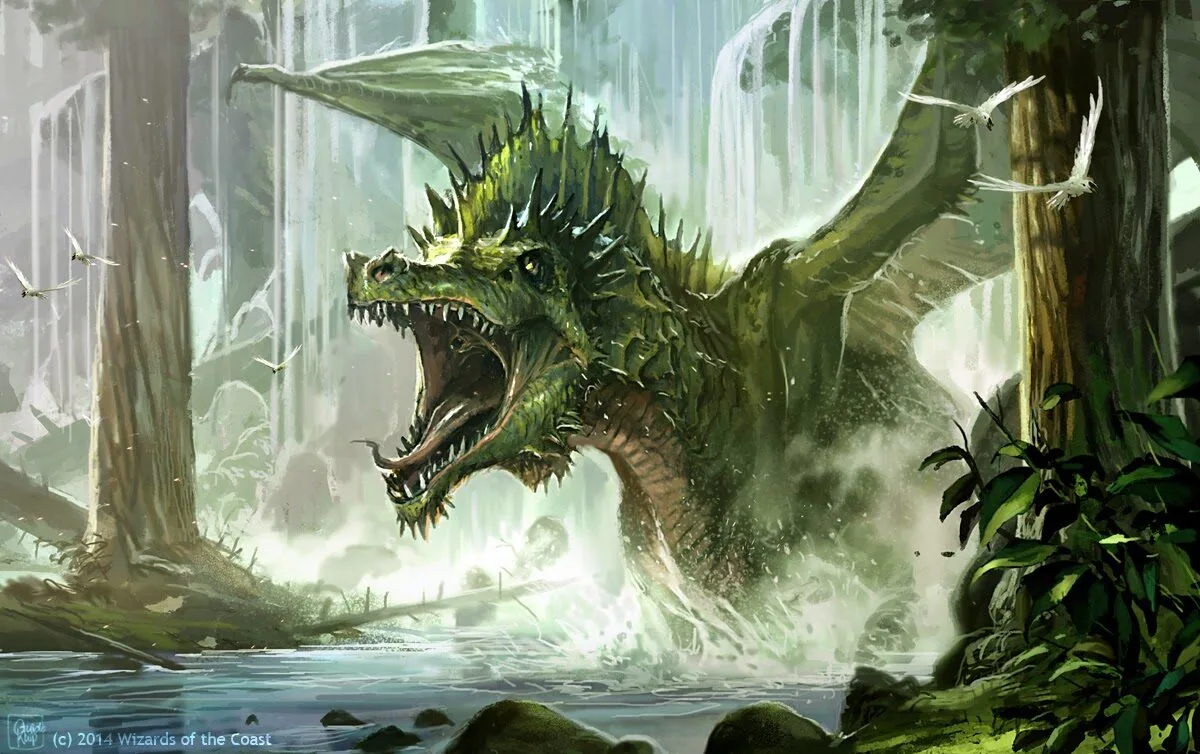
A green dragon bursts out of the waterfall with its mouth open. Nobody at the table needs the stat block read out. You know what it is, you know what it wants, and you know how you feel about it.
That is the gift of dragons: they are obvious. The game is named for them. They are the one monster everyone recognises, and the one fight everyone remembers.
This post is about the feeling the roar brings up, which is often anger, and why that is useful. Tia brings the psychology; Rohan brings the stat block and the objections.
Why the dragon, and not the goblin
In 1909 G. K. Chesterton answered people who thought fairy tales frighten children. His reply is the best short defence of dragons ever written:
"Fairy tales do not give the child his first idea of bogey. What fairy tales give the child is his first clear idea of the possible defeat of bogey. The baby has known the dragon intimately ever since he had an imagination. What the fairy tale provides for him is a St. George to kill the dragon." [1]
Chesterton's point: the fear comes first. The story adds the limit. His next line says fairy tales teach "that these limitless terrors had a limit" [1].
Everyone has a life dragon. The debt, the diagnosis, the boss, the court date, the person who hurt you. It is big, it is obvious, and it sits on something you want. A dragon at the table gives that feeling a shape, a hit point total, and an Armor Class. A thing with 136 Hit Points can be beaten. A shapeless dread can't.
Meet the dragon on our cover
The green dragon is a liar. Look at the Young Green Dragon in the SRD 5.2.1: a Large Chromatic Dragon, AC 18, 136 Hit Points, Challenge Rating 8. It has Deception +5 and speaks Common and Draconic. It makes three Rend attacks, each "11 (2d6 + 4) Slashing damage plus 7 (2d6) Poison damage", and it has a Poison Breath: a 30-foot Cone, DC 14 Constitution save, 42 (12d6) Poison damage on a failure, half on a success, recharging on a 5 or 6 [2].
Its grown-up form, the Adult Green Dragon, adds spells: Mind Spike at will and Geas once a day [2]. It gets in your head and gives you orders.
Tia's note: that is a good picture of the life dragons people carry. The worst of them talk. They tell you it's your fault, you can't win, and you should do what they say.
Anger is a tool, and the research agrees
Most people treat anger as a failure of manners. Psychology treats it as a tool with a job.
People choose anger when a fight is coming. In 2008 Maya Tamir, Christopher Mitchell and James Gross asked people to pick activities before playing a computer game. When the game ahead was confrontational, they chose activities that would make them angrier (but not merely more excited). When the game was not confrontational, they didn't. And anger improved performance in the confrontational task, not in the other one [3]. The authors' conclusion: people "may choose to experience emotions that are instrumental, despite short-term hedonic costs" [3]. In plain words, people pick the unpleasant feeling when it helps them win.
Anger helps when the goal is hard. In 2023 Heather Lench and colleagues at Texas A&M ran seven studies on it. Their summary: "anger compared to a neutral condition resulted in behavior that facilitated greater goal attainment on tasks that involved challenges" [4]. Some of what they found:
- Angry participants solved more difficult puzzles [4].
- In a skiing video game, angry players scored better on the slalom (steer around the flags) than neutral players. On the easy ski jump, emotion made no difference [4].
- Angry participants cheated more to win prizes: 57% against 27% in the neutral condition [4].
Read that last one twice. Anger pushes you through obstacles, and a rule can look like an obstacle. The dragon is a fine thing to be angry at. Your party is not.
Two honest limits. In the skiing study, angry players did not beat amused players by a significant margin, so some of the benefit may come from being worked up at all [4]. And anger helped on the hard task, not the easy one [4]. Anger is for dragons, not for doors.
Rage by the rules: the SRD already knows this
D&D has a class built on this idea. The Barbarian's Rage reads like a psychologist wrote it (SRD 5.2.1, Barbarian, Level 1: Rage) [2]:
| Rage rule | What it says | What it means for real anger |
|---|---|---|
| Entering | "You can enter it as a Bonus Action" | You choose it. It doesn't choose you. |
| Pointed at an enemy | It lasts to the end of your next turn; to extend it, you attack an enemy, force an enemy to save, or spend a Bonus Action | Anger needs a target. Take away the fight and it runs out. |
| Time limit | "You can maintain a Rage for up to 10 minutes" | It is a burst, not a lifestyle. |
| Narrowing | "You can't maintain Concentration, and you can't cast spells" | Angry people are strong and not subtle. |
| Armour | Resistance to Bludgeoning, Piercing and Slashing damage | It helps you take the hits. |
Here is how much it helps. A level 5 Barbarian (Constitution 16, Dexterity 14, no armour, so AC 15, and 55 Hit Points on the fixed value) fights the Young Green Dragon. We computed every roll by script:
| Young Green Dragon attack | Expected damage, not raging | Expected damage, raging |
|---|---|---|
| Multiattack (three Rends, crits included) | 37.2 | 25.5 |
| Poison Breath (save +6 vs DC 14, 65% chance to save) | 28.2 | 28.2 |
Rage cuts a round of claws by about a third. It does nothing at all to the breath. Rage resists slashing; it does not resist Poison [2].
The poison Rage can't stop: rumination
That gap in the maths is the whole lesson about real anger.
Anger helps you take the hits while you fight. It doesn't protect you from the poison afterwards, and the poison has a name: rumination, replaying the thing over and over.
In 2002 Brad Bushman angered participants, then had some hit a punching bag while thinking about the person who angered them. Others hit the bag while thinking about getting fit, and a control group did nothing. The ruminators felt angriest and acted most aggressively. The control group, who did nothing, came out best. In Bushman's words: "Rumination increased rather than decreased anger and aggression. Doing nothing at all was more effective than venting anger" [5].
In 2024 Sophie Kjærvik and Bushman pooled 154 studies with 10,189 participants. Activities that raise arousal (hitting a bag, jogging, cycling) did not calm anger. Activities that lower it (slow breathing, mindfulness, meditation) did [6].
So the pillow you punch is not your dragon. Pounding it while you picture a face is poison, not a sword.
Name the dragon
One more study, and it is the best reason to play. In 2007 Matthew Lieberman and colleagues scanned the brains of 30 people looking at angry and fearful faces. When they picked the word that matched the face ("angry", "fearful"), activity in the amygdala, the brain's alarm, dropped. When they picked a name for the face instead ("Harry", "Sally"), it didn't [7][8]. The researchers called it affect labeling.
That is what a dragon does for you. It turns a shapeless feeling into something with a name, a stat block and a fight you can finish in an evening.
For players:
- Name your character's dragon on the sheet. "The fire that took my village" works. So does "My father's debts."
- Point the anger at the dragon. The Rage rules do it for you: no enemy, no Rage.
- End the Rage when the fight ends. Ten minutes, then you're a person again.
For Dungeon Masters:
- Make the big bad obvious. Chesterton's children knew the dragon on sight [1]. Players who have to guess what they're angry at can't use the anger.
- Give the anger a goal that is hard, not a door that's locked. Anger helps with challenges [4], and a locked door isn't one.
- Watch for anger leaking onto the party. If players start blaming each other, the dragon won. Pause and put it back on the dragon.
The short of it
- A dragon gives a shapeless fear a name, a stat block and an end [1].
- Anger helps on hard, confrontational tasks [3][4]. It also makes people cut corners [4].
- The Barbarian's Rage is anger with rules: chosen, aimed, time-limited [2].
- Rage cuts the claws by a third and the poison by nothing. Rumination is the poison [5].
- Calm beats venting [6]. Naming the feeling turns the alarm down [7].
Roll the Young Green Dragon's breath on the main roller: type 12d6 and see what your life dragon hits for. Then roll it in the 3D table and hit it back.
How we got the numbers: exact calculation by script over every d20 and damage roll. Level 5 Barbarian with Constitution 16 and Dexterity 14 (AC 15 unarmoured, Constitution save +6 with proficiency, 55 Hit Points by fixed value). Rage resistance halves the Slashing part of each Rend, rounded down.
Table Talk
Tia: Dragons work because they're obvious. Everyone's got a life dragon, and a stat block makes it beatable.
Rohan: Or a dragon is a big lizard with 136 hit points and you're overthinking it.
Tia: The rules agree with me. Rage needs an enemy or it runs out.
Rohan: The rules say Rage cuts the claws by a third and does nothing to the breath. That's a maths fact, not a metaphor.
Tia: It's both. Anger takes the hits. It doesn't stop the poison afterwards. That's rumination.
Rohan: Fine. Then my tip: when the dragon recharges on a 5 or 6, stop being angry and spread out. Four people in one cone is a bad plan.
Tia: And mine: name your dragon on the character sheet. Then go fight it.
References
- Chesterton, G. K. (1909). Tremendous Trifles. Essay XVII, "The Red Angel". London: Methuen. Project Gutenberg eBook #8092. https://www.gutenberg.org/ebooks/8092
- Wizards of the Coast. System Reference Document 5.2.1. 2025. CC-BY-4.0. Sections: "Monsters" (Young Green Dragon, Adult Green Dragon); "Classes" (Barbarian, Level 1: Rage; Fixed Hit Points by Class). https://media.dndbeyond.com/compendium-images/srd/5.2/SRD_CC_v5.2.1.pdf
- Tamir, M., Mitchell, C., & Gross, J. J. (2008). Hedonic and instrumental motives in anger regulation. Psychological Science, 19(4), 324–328. https://doi.org/10.1111/j.1467-9280.2008.02088.x
- Lench, H. C., Reed, N. T., George, T., Kaiser, K. A., & North, S. G. (2024). Anger has benefits for attaining goals. Journal of Personality and Social Psychology, 126(4), 587–602. https://doi.org/10.1037/pspa0000350
- Bushman, B. J. (2002). Does venting anger feed or extinguish the flame? Catharsis, rumination, distraction, anger, and aggressive responding. Personality and Social Psychology Bulletin, 28(6), 724–731. https://doi.org/10.1177/0146167202289002
- Kjærvik, S. L., & Bushman, B. J. (2024). A meta-analytic review of anger management activities that increase or decrease arousal: What fuels or douses rage? Clinical Psychology Review, 109, 102414. https://doi.org/10.1016/j.cpr.2024.102414
- Lieberman, M. D., Eisenberger, N. I., Crockett, M. J., Tom, S. M., Pfeifer, J. H., & Way, B. M. (2007). Putting feelings into words: Affect labeling disrupts amygdala activity in response to affective stimuli. Psychological Science, 18(5), 421–428. https://doi.org/10.1111/j.1467-9280.2007.01916.x
- UCLA Health. (2007). Putting feelings into words produces therapeutic effects in the brain. News release. https://www.uclahealth.org/news/release/putting-feelings-into-words-produces-therapeutic-effects-in-the-brain-ucla-neuroimaging-study-supports-ancient-buddhist-teachings