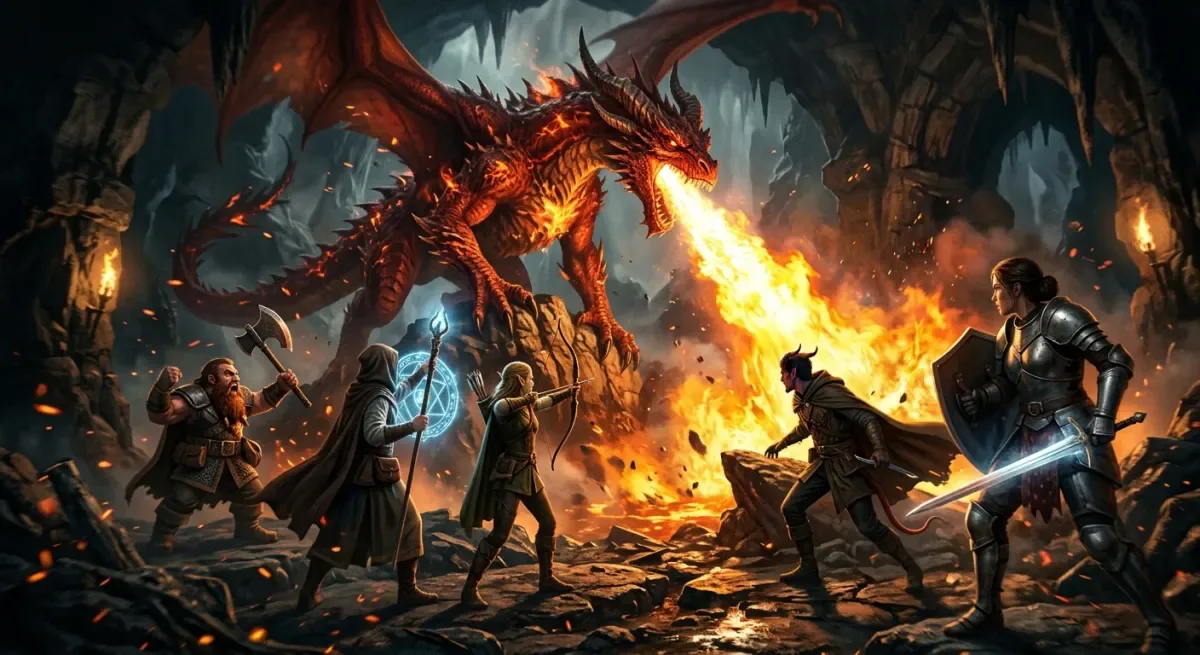
In the 2014 rules a greatsword and a maul were the same weapon with different paint: 2d6 damage, Heavy, Two-Handed. In the 2024 rules they play differently. The greatsword Grazes: it hurts even when it misses. The maul Topples: it knocks the target flat. That difference is weapon mastery, the biggest change the 2024 Player's Handbook made to martial characters, and it is all in the free System Reference Document 5.2.1 [1].
Arthur has run fifth edition since the week it came out and reads rules the way other people read contracts. Rohan wants the numbers. This post gives you both: what each of the eight mastery properties does, word for word from the SRD, who gets them, the odds worked out, and which one to pick.
What weapon mastery is
Every weapon in the 2024 Weapons table now has a Mastery column. The SRD is plain about it: "Each weapon has a mastery property, which is usable only by a character who has a feature, such as Weapon Mastery, that unlocks the property for the character" (SRD 5.2.1, "Equipment", Mastery Properties) [1].
So a wizard who picks up a greatsword swings a greatsword. A fighter who picks up a greatsword swings a greatsword that Grazes.
The 2014 rules have nothing like it. The SRD 5.1 Weapons table lists cost, damage, weight and properties, and stops there [2].
Who gets it, and how many
Five classes get Weapon Mastery at level 1. Each picks "kinds" of weapon (Longswords, Javelins), not single weapons [1].
| Class | Masteries at level 1 | Grows to | Limits |
|---|---|---|---|
| Fighter | 3 | 4 at level 4, 5 at 10, 6 at 16 | Any Simple or Martial weapon |
| Barbarian | 2 | 3 at level 4, 4 at 10 | Simple or Martial Melee weapons only |
| Paladin | 2 | 2 | Weapons you're proficient with |
| Ranger | 2 | 2 | Weapons you're proficient with |
| Rogue | 2 | 2 | Weapons you're proficient with |
All five can change their picks after a Long Rest. Barbarians and Fighters "practice weapon drills" and change one; Paladins, Rangers and Rogues can change the lot [1].
Fighters get one more trick at level 9, Tactical Master: when you attack with a weapon whose mastery you can use, "you can replace that property with the Push, Sap, or Slow property for that attack" [1]. Your greatsword Grazes all day, and Pushes when the enemy is standing next to a cliff.
The eight properties, straight from the SRD
Quoted from SRD 5.2.1, "Equipment", Mastery Properties [1]:
- Cleave. Hit a creature with a melee attack, and you can make a second melee attack roll "against a second creature within 5 feet of the first that is also within your reach." No ability modifier on that damage. Once per turn. Greataxe, Halberd.
- Graze. "If your attack roll with this weapon misses a creature, you can deal damage to that creature equal to the ability modifier you used to make the attack roll." Glaive, Greatsword.
- Nick. The extra attack from the Light property happens "as part of the Attack action instead of as a Bonus Action." Once per turn. Dagger, Light Hammer, Sickle, Scimitar.
- Push. On a hit, push the creature "up to 10 feet straight away from yourself if it is Large or smaller." Greatclub, Pike, Warhammer, Heavy Crossbow.
- Sap. On a hit, the creature "has Disadvantage on its next attack roll before the start of your next turn." Mace, Spear, Flail, Longsword, Morningstar, War Pick.
- Slow. Hit and deal damage, and you can cut its Speed by 10 feet until the start of your next turn. Hits from several Slow weapons don't stack past 10 feet. Club, Javelin, Light Crossbow, Sling, Whip, Longbow, Musket.
- Topple. On a hit, the creature makes a Constitution saving throw, DC 8 + the ability modifier you attacked with + your Proficiency Bonus, or it has the Prone condition. Quarterstaff, Battleaxe, Lance, Maul, Trident.
- Vex. Hit and deal damage, and "you have Advantage on your next attack roll against that creature before the end of your next turn." Handaxe, Dart, Shortbow, Rapier, Shortsword, Blowgun, Hand Crossbow, Pistol.
Arthur's favourite line in the table: the humble quarterstaff, a 2 SP stick, has Topple. So does the 10 GP maul.
The odds, worked out
Rohan's rule: no mastery gets picked on vibes. Here is a level 1 character with Strength 16 (+3) and a +2 Proficiency Bonus, so +5 to hit and a Topple DC of 13. A 20 is a critical hit (damage dice doubled); a 1 always misses. Every number below is exact, computed over every d20 result and every damage roll [3].
Targets from the site's own stat blocks: the Goblin Warrior (AC 15, Con +0) and the Ogre (AC 11, Con +3) [1].
Graze vs Cleave: the two-handed choice
Average damage per swing:
| Weapon and mastery | vs Goblin Warrior (AC 15) | vs Ogre (AC 11) |
|---|---|---|
| Greatsword 2d6+3, no mastery | 5.85 | 7.85 |
| Greatsword 2d6+3, Graze | 7.20 | 8.60 |
| Greataxe 1d12+3, no mastery | 5.55 | 7.45 |
| Greataxe 1d12+3, Cleave (second enemy adjacent) | 7.70 | 11.35 |
Graze adds 1.35 damage a swing against the goblin: you miss 45% of the time, and every one of those misses still does 3. That's a 23% raise, and it never depends on where anyone stands.
Cleave adds more, but only when a second enemy stands within 5 feet of the first and within your reach. Against the ogre with a friend beside it, Cleave wins by almost three points. Against a lone ogre, the greataxe is the worst weapon on the table.
Rohan's verdict: Graze is the reliable one. Cleave is the fun one when the DM sends a crowd.
Vex: advantage you make yourself
Hit with a Vex weapon and your next attack on that target has Advantage. With a 55% hit chance against the goblin, Advantage lifts the next attack to 79.75%. Against the ogre, 75% becomes 93.75%. (Why Advantage is worth so much: our advantage and disadvantage guide.)
Rogues love this. Sneak Attack wants Advantage, and a shortbow or rapier hands it to you after every hit.
Topple: knock it down, let the party pile on
A hit with Topple forces a DC 13 Constitution save. The goblin (Con +0) fails 60% of the time; the ogre (Con +3) fails 45%. Multiply by the hit chance and one swing puts the target Prone:
| Target | Hit chance | Fails the save | Prone per swing |
|---|---|---|---|
| Goblin Warrior | 55% | 60% | 33.0% |
| Ogre | 75% | 45% | 33.75% |
About one swing in three, against either. The payoff: an attack roll against a Prone creature "has Advantage if the attacker is within 5 feet" (Rules Glossary, Prone) [1]. An ally with the same +5 goes from 55% to 79.75%. Standing up costs the target half its Speed.
Sap: the defensive pick
A goblin's Scimitar attacks at +4. Against a fighter in chain mail (AC 16) it hits 45% of the time. Sapped, with Disadvantage, it hits 20.25%. Sap more than halves the goblin's next attack. It is the pick for the party's front line and for anyone guarding a squishy wizard.
Nick: the dual-wielder's action economy
In the 2014 rules, the second attack with an off-hand Light weapon costs your Bonus Action (SRD 5.1, "Combat", Two-Weapon Fighting) [2]. With Nick it's part of the Attack action [1]. Scimitar (Nick) in one hand, shortsword (Vex) in the other: two attacks at level 1, the second with Advantage if the first hits, and your Bonus Action still free. From level 2 a Rogue spends it on Cunning Action.
Why mastery feels good to play
Weapon mastery fixes a feeling, not only a number.
Every turn is a choice. Ryan, Rigby and Przybylski studied why people keep playing games. Across four studies, players' sense of competence and autonomy (the feeling of acting by your own choice) predicted how much they enjoyed a game and whether they kept playing it [4]. A 2014 fighter at level 1 has one move: attack. A 2024 fighter chooses: Graze the goblin or Topple the ogre, Sap the one threatening the wizard, Push the cultist into the fire. That is autonomy you can hold in one hand.
The whiff hurts less. Clark and colleagues found that a near-miss on a slot machine felt worse than a clear miss, yet made people want to play more, and it lit up brain areas that also respond to wins [5]. Graze is the opposite trick: it takes the sting out of the miss by making it count for something. Three damage on a miss is small. Watching the goblin flinch anyway is not.
A short menu beats a long one. Iyengar and Lepper set up a jam-tasting table in a grocery store. When 24 flavours were on display, 3% of shoppers who stopped bought a jar. With 6 flavours, 30% bought [6]. Weapon mastery keeps your menu short: two or three properties, each one line long, tied to the weapon already in your hand. New players learn them in one session.
Which one to pick
- New to the game: Greatsword (Graze). No positioning, no conditions, more damage every turn.
- Tank or defender: Longsword or Flail (Sap). Your enemy's next attack gets Disadvantage.
- Rogue: Shortbow or Rapier (Vex), plus a Scimitar or Dagger (Nick) if you dual-wield.
- Team player: Maul or Quarterstaff (Topple). One swing in three knocks it down for everyone.
- Crowds: Greataxe or Halberd (Cleave).
- Archer who wants control: Longbow (Slow) keeps a charging enemy off the wizard.
- Fighter level 9+: take Graze or Cleave as your main, and let Tactical Master hand you Push, Sap or Slow on the turn it matters.
Roll the numbers yourself on the dice roller: 2d6+3 for the greatsword, 1d12+3 for the greataxe, and count how often the 3 on a miss decides the fight.
Table Talk
Rohan: Graze. Every time. Forty-five percent of your swings miss and they still do three.
Arthur: Three. The ogre has 68 Hit Points.
Rohan: Three every miss, every turn, from level 1. Add it up over a campaign.
Arthur: And Topple puts the ogre on the floor one swing in three, and then the whole party has Advantage. That's everyone's damage going up, not only yours.
Rohan: If the party's standing next to it. Mine never are.
Arthur: Then your party needs a fighter with a maul and a talk about positioning.
Rohan: My tip: before the session, write your two masteries on a sticky note on your sheet. You'll forget Graze exists by round three otherwise.
Arthur: Mine: if you're a Fighter, change one mastery after every Long Rest to fit tomorrow's dungeon. The rules let you. Almost nobody does.
References
- Wizards of the Coast. System Reference Document 5.2.1. 2025. CC-BY-4.0. Sections: "Equipment" (Weapons, Properties, Mastery Properties, Weapons table); "Classes" (Barbarian, Fighter, Paladin, Ranger and Rogue: Weapon Mastery; Fighter: Tactical Master); "Rules Glossary" (Prone); "Monsters" (Goblin Warrior, Ogre). https://media.dndbeyond.com/compendium-images/srd/5.2/SRD_CC_v5.2.1.pdf
- Wizards of the Coast. System Reference Document 5.1. 2016. CC-BY-4.0. Sections: "Equipment" (Weapons); "Combat" (Two-Weapon Fighting). https://media.wizards.com/2023/downloads/dnd/SRD_CC_v5.1.pdf
- DnD Dice Roller. Weapon mastery odds script: exact enumeration of the d20 and every damage die; level 1, +5 to hit, +3 damage, DC 13, natural 20 doubles damage dice, natural 1 misses. 2026.
- Ryan, R. M., Rigby, C. S., & Przybylski, A. (2006). The motivational pull of video games: A self-determination theory approach. Motivation and Emotion, 30(4), 344–360. https://doi.org/10.1007/s11031-006-9051-8
- Clark, L., Lawrence, A. J., Astley-Jones, F., & Gray, N. (2009). Gambling near-misses enhance motivation to gamble and recruit win-related brain circuitry. Neuron, 61(3), 481–490. https://doi.org/10.1016/j.neuron.2008.12.031
- Iyengar, S. S., & Lepper, M. R. (2000). When choice is demotivating: Can one desire too much of a good thing? Journal of Personality and Social Psychology, 79(6), 995–1006. https://doi.org/10.1037/0022-3514.79.6.995