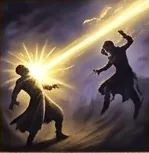
Guiding Bolt
1st-level evocation · 4d6 Radiant damage, average 14
14 average Radiant damage · 4–24
Roll Guiding Bolt
Press a roll button. The dice land here.
Spell details
- Level
- 1st-level
- School
- Evocation
- Casting time
- Action
- Range
- 120 feet
- Components
- V, S
- Duration
- 1 round
- Classes
- Cleric
- Attack
- Ranged spell attack
Guiding Bolt is half damage, half an assist, and the assist is often worth more
At the table. Guiding Bolt is a level 1 Cleric spell: an action, 120 feet, a ranged spell attack. A hit deals 4d6 Radiant damage (14 on average), and the next attack roll made against the target before the end of your next turn has Advantage. Each slot level above 1 adds 1d6. It isn't Concentration, so it won't cost you your Bless or Spiritual Weapon.
What changed from 2014. The rules are the same in SRD 5.1 and SRD 5.2.1: 4d6 radiant, Advantage on the next attack, +1d6 per slot level.
How much it gives. With a +5 spell attack, and an ally with +5 attacking next:
| Target AC | Bolt hits | Expected bolt damage | Ally's next attack |
|---|---|---|---|
| 13 | 65% | 9.8 | 65% → 87.75% |
| 15 | 55% | 8.4 | 55% → 79.75% |
| 18 | 40% | 6.3 | 40% → 64% |
The Advantage is worth the most when the ally's hit matters most: the rogue who needs Advantage for Sneak Attack, the paladin about to spend a Smite, or anyone aiming to finish the target.
The choice that matters is turn order. The Advantage goes to the next attack roll against the target, from anyone, including an enemy. So bolt the target when a friend acts right after you, before a monster's minion takes the Advantage with a swing of its own.
The common mistake is firing it at the monster with the highest AC. That's when the bolt is most likely to miss, and when it does, there's no Advantage for anyone. We explain the Advantage maths in full in Advantage and Disadvantage in D&D.
The human angle. Guiding Bolt is a gift spell. The cleric's turn sets up someone else's moment. Dunn, Aknin and Norton found people who spent money on others reported more happiness than those who spent it on themselves. Players who set up a friend's big hit tend to cheer the loudest when the dice land.
Source: Dunn, E. W., Aknin, L. B., & Norton, M. I. (2008). Spending money on others promotes happiness. Science, 319(5870), 1687–1688. doi:10.1126/science.1150952
Guiding Bolt damage by level
| Cast at | Dice | Average | Range | Critical |
|---|---|---|---|---|
| 1st slot | 14 | 4–24 | 28 | |
| 2nd slot | 17.5 | 5–30 | 35 | |
| 3rd slot | 21 | 6–36 | 42 | |
| 4th slot | 24.5 | 7–42 | 49 | |
| 5th slot | 28 | 8–48 | 56 | |
| 6th slot | 31.5 | 9–54 | 63 | |
| 7th slot | 35 | 10–60 | 70 | |
| 8th slot | 38.5 | 11–66 | 77 | |
| 9th slot | 42 | 12–72 | 84 |
The odds of 4d6
| Total | Chance |
|---|---|
| 9 or more | 95% |
| 14 or more | 56% |
| 19 or more | 10% |
| 22 or more | 1% |
Guiding Bolt against other 1st-level damage spells
By average damage on one target, Guiding Bolt ranks 1st of 15 1st-level damage spells in the SRD. Area, saves and riders are not counted here; read each spell.
| Spell | Dice | Average |
|---|---|---|
| Guiding Bolt | 4d6 | 14 |
| Hellish Rebuke | 2d10 | 11 |
| Inflict Wounds | 2d10 | 11 |
| Burning Hands | 3d6 | 10.5 |
| Dissonant Whispers | 3d6 | 10.5 |
| Magic Missile | 3d4 + 3 | 10.5 |
| Divine Smite | 2d8 | 9 |
| Ray of Sickness | 2d8 | 9 |
| Thunderwave | 2d8 | 9 |
| Ice Knife | 1d10 | 5.5 |
| Ensnaring Strike | 1d6 | 3.5 |
| Hex | 1d6 | 3.5 |
| Hunter's Mark | 1d6 | 3.5 |
| Searing Smite | 1d6 | 3.5 |
| Divine Favor | 1d4 | 2.5 |
Rules text
You hurl a bolt of light toward a creature within range. Make a ranged spell attack against the target. On a hit, it takes Radiant damage, and the next attack roll made against it before the end of your next turn has Advantage.
At higher levels. The damage increases by for each spell slot level above 1.
This page includes material from the System Reference Document 5.2.1 (“SRD 5.2.1”) by Wizards of the Coast LLC, available at dndbeyond.com/srd. The SRD 5.2.1 is licensed under the Creative Commons Attribution 4.0 International License. The averages, odds and tables are ours.